

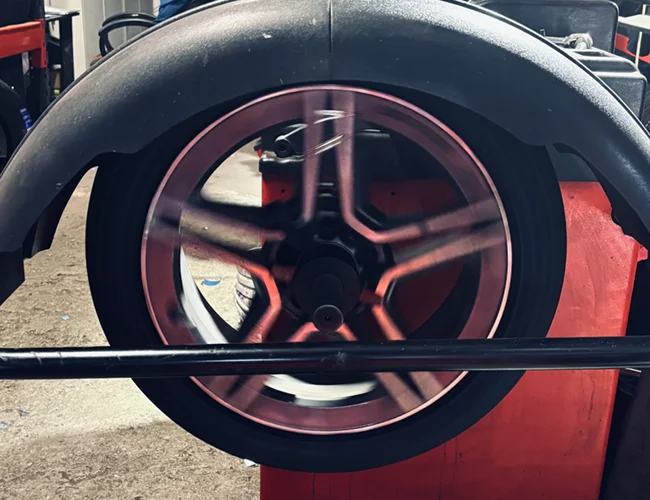
What that steering wheel wobble could be telling you
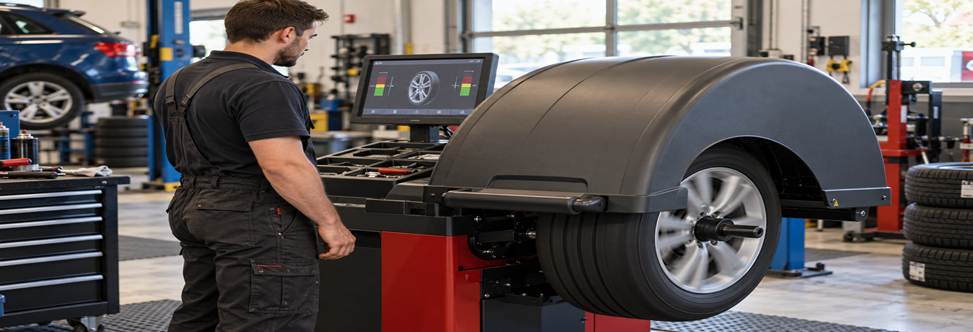
Wheel balancing checks how weight is distributed around the wheel and tyre as they rotate.
A familiar journey should not feel like hard work
Whether you are heading along the A41, joining the M53 or making the school run in Wallasey, an unexpected vibration can make an ordinary drive uncomfortable.
Perhaps the steering wheel has developed a tremble, or you can feel a shake through the seat that was not there before. It might be a wheel balancing issue, although other faults can cause similar symptoms.
At Tyres 4 U Wirral, we can check the wheels and tyres and explain whether balancing is needed. The useful first step is finding the cause, rather than getting used to the vibration.
What is wheel balancing
A wheel and tyre may look evenly shaped, but their weight is not always distributed evenly around the assembly. One area can be slightly heavier than another.
As the wheel rotates, that imbalance can produce a vibration. It may become noticeable at a particular road speed, even if the car feels reasonably smooth at other times.
Balancing uses a machine to identify the imbalance. Small weights are then fitted to the wheel in the appropriate places to help it rotate smoothly.
Even new tyres need balancing
A brand-new tyre does not automatically make a perfectly balanced wheel. The tyre, rim and valve form an assembly, and small differences can add up.
That is why balancing is part of fitting a tyre properly. The tyre does not have to be worn or damaged to need it. Premium tyres need balancing too; it is about the complete wheel and tyre, rather than how much the tyre cost.
Small weights can make a noticeable difference
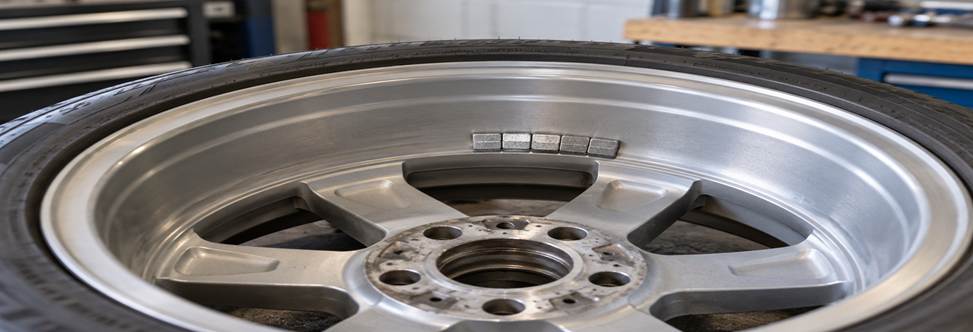
These small wheel weights compensate for an imbalance. They are there for a reason.
What signs should you look out for
A vibration through the steering wheel, seat or floor can be a reason to have the wheels checked. You might notice it at certain speeds and not others.
Tell us where you feel it, when it started and whether it happens during normal driving or mainly when braking. Mention any recent tyre work or pothole impact. That information helps us decide what to inspect.
Do not deliberately drive faster to test a vibration. Describe what you have already noticed on your usual journeys.
Why a wheel can need balancing again
A balance weight can become detached, or changes in tyre wear can affect the assembly over time. An impact can also damage a wheel or tyre and create a vibration.
After hitting a pothole, balancing is not automatically the whole answer. The wheel and tyre need checking for damage too. A bent wheel or damaged tyre cannot simply be made sound by adding more weights.
It is about more than comfort
Correcting an imbalance can help reduce vibration and avoid the uneven tyre wear associated with it. Persistent vibration can also put additional strain on steering and suspension parts.
Balancing cannot put worn tread back or repair an existing mechanical fault. Catching a new vibration early gives us a chance to investigate before it causes further inconvenience.
Can I tell which wheel is responsible
Where you feel a vibration can offer clues, but it is not a reliable diagnosis on its own. A steering wheel tremble does not prove that one particular front tyre needs balancing.
If the vibration is sudden, severe or accompanied by damage, unusual noises or unstable handling, stop somewhere safe and arrange help. Do not assume it is a minor balance problem and carry on.
Balancing alignment and what to do next
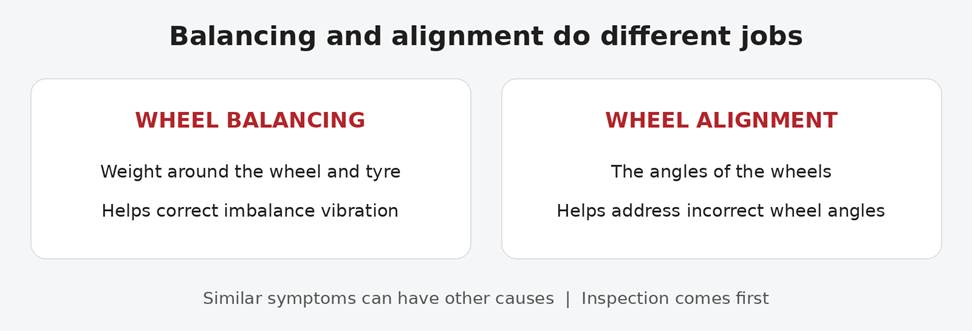
Both services matter, but they deal with different things. The symptoms need assessing first.
Is balancing the same as alignment
No. Balancing corrects uneven weight distribution around a wheel and tyre. Alignment checks and, where needed, adjusts the angles of the wheels to the vehicle manufacturer’s settings.
A vibration may suggest a balance issue. Pulling to one side, an off-centre steering wheel or certain wear patterns may suggest alignment. These are clues, not a diagnosis, because tyre, wheel, brake and suspension faults can produce similar symptoms.
Booking one service will not automatically solve a problem caused by the other. Tell us what the car is doing and we can explain the appropriate checks.
When should wheels be balanced
Balancing is needed when new tyres are fitted and when a tyre is removed and refitted to its wheel, such as during a suitable puncture repair.
It is also worth having a new vibration or unusual tyre wear investigated. Follow any recommendations in your vehicle handbook rather than assuming every car needs balancing at exactly the same mileage.
If the car is smooth and there are no signs of a problem, there is no need to assume all four wheels must be rebalanced every few months.
What happens at the garage
The wheel and tyre are removed from the car and mounted on a balancing machine. The machine measures the imbalance and shows where correction weights are needed. The result is checked after adjustment.
If vibration remains despite a satisfactory balance, another cause may need investigating. We will explain what we find rather than promise that balancing fixes every shake.
A smoother journey starts with the right check
If your commute has developed an unwelcome wobble, call Tyres 4 U Wirral on 0151 638 0906 or visit our garage on Kelvin Road, Wallasey, CH44 7JW.
We offer wheel balancing, wheel alignment and free tyre safety checks. Let us know what you have noticed and we will help you understand the next step.
You do not need to know the technical name for the problem. A clear description of how the car feels is a useful place to start.