
A simple habit that helps your tyres and battery work efficiently
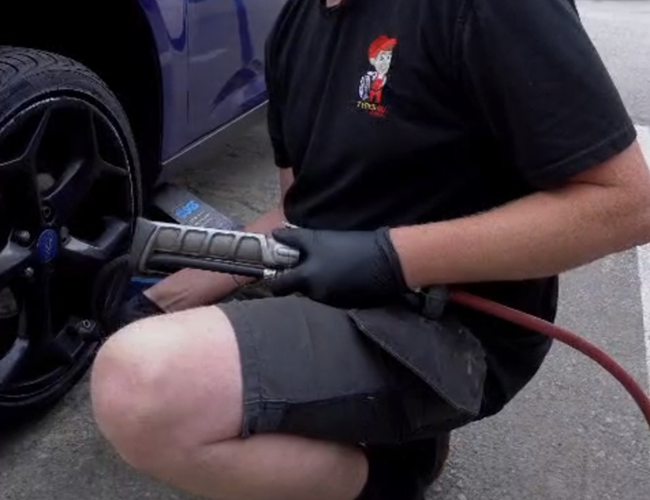
A pressure check is a small job that helps you avoid unnecessary energy use.
Before you plan your next charging stop
If you drive an electric car, you probably keep an eye on the range display. A longer journey, a cold morning or an unexpected diversion can make those remaining miles feel rather important.
There are plenty of things that affect range, but one easy place to start is your tyres. If they are underinflated, your car may use more energy than it needs to.
Keeping them at the correct pressure helps you get the best from the tyres already fitted. It also supports safe handling and helps avoid unnecessary wear. No special gadget or complicated calculation is needed, just the right information and a reliable check.
Why soft tyres can use more electricity
As a tyre rolls, it changes shape where it meets the road. When the pressure is too low, it can flex more than intended, creating extra resistance. Your car then needs more energy to keep moving.
You may hear this called rolling resistance. In everyday terms, it is some of the effort needed to roll the tyres along the road. Correct pressure helps avoid adding unnecessary resistance.
How much extra range will I get
There is no fixed number of miles to promise. It depends on how low the pressures were, the car, the tyres and the journey. If your tyres are already correctly inflated, there may be no pressure-related range loss to recover.
Think of a pressure check as preventing waste, rather than a way to transform your car’s advertised range. It is one useful part of looking after an EV.
Find the right pressure for your car
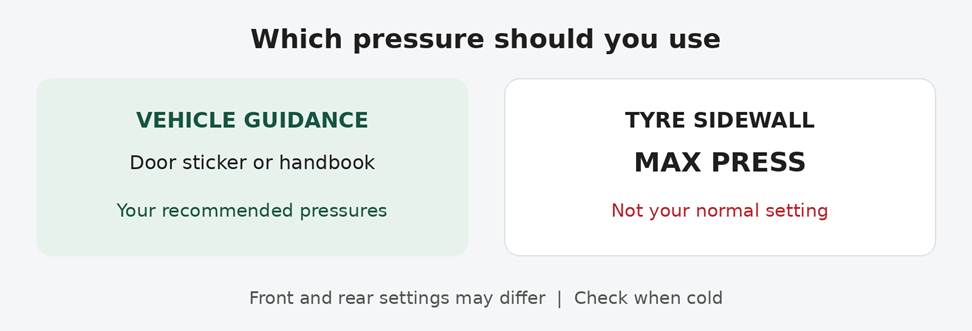
Your vehicle’s guidance is the starting point. There is no single pressure for every EV.
Look at the car not the tyre sidewall
Use the recommended pressures for your vehicle and tyre size. You will usually find them on a sticker around a door opening, inside the fuel or charging flap on some vehicles, or in the handbook. The exact location varies.
The maximum pressure printed on the tyre sidewall is not the number to copy. It describes a tyre limit, rather than the normal setting for your particular car.
If you cannot find the information, ask us to help identify it. Do not use another EV owner’s pressure simply because their car looks similar.
Front rear and full load settings may differ
Some vehicles specify different pressures for the front and rear tyres. There may also be separate settings for different wheel sizes or a heavier load.
Before a trip with passengers and luggage, check the appropriate guidance. If you are towing, use the vehicle’s specific towing instructions. Do not add an arbitrary amount of air because the car feels heavily loaded.
What does check when cold mean
Cold means the tyres have not warmed up through driving. A good time to check is before your first journey, after the car has been parked for several hours. Follow the timing in your handbook.
Pressures normally rise as tyres warm up on the road. Do not let air out of warm tyres simply to match a recommended cold figure. Recheck them when cold, or ask for advice if a warm check is unavoidable.
More air is not a range shortcut
It can be tempting to add a little extra in the hope of squeezing out more miles. Avoid experimenting beyond the vehicle’s approved settings.
Overinflation can affect grip, comfort and wear. The aim is the correct pressure for your car and load, rather than the highest pressure you can put into the tyre.
Cold weather and the dashboard warning
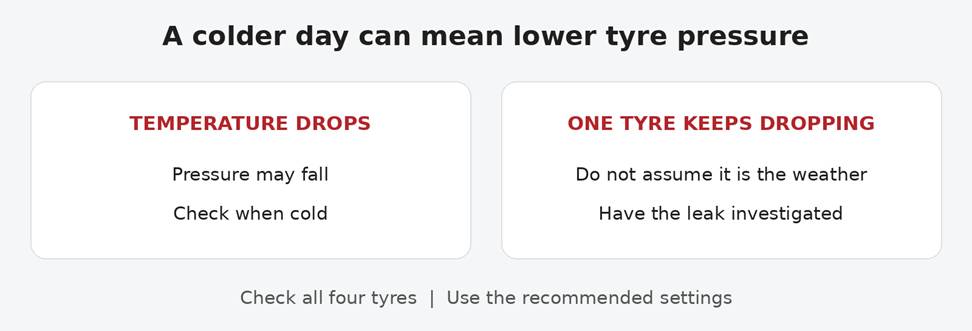
Temperature can change tyre pressure, but repeated pressure loss still needs investigating.
Why a cold morning can trigger a warning
When the weather gets colder, tyre pressure can fall. A tyre that was correctly set in warmer conditions may therefore need attention after a temperature drop.
That does not automatically mean there is a puncture. But it is not a reason to ignore the warning either. Check all four tyres and adjust them to the correct cold settings.
If one tyre repeatedly loses more pressure than the others, have it examined. A slow puncture, valve leak or problem with the seal against the wheel may be responsible.
Does TPMS do the checking for me
Your tyre pressure monitoring system, or TPMS, is a useful warning system. Some cars display pressure readings; others warn of a possible loss without showing a number for each wheel.
It does not replace routine checks. A warning may only appear once pressure has fallen significantly, and the system may not account for a change in the load you are carrying.
If your car requires a reset or calibration after pressures are adjusted, follow the handbook. Correct the pressures first. Resetting the warning is not a repair.
What if the range still drops in winter
Tyre pressure is only one part of the picture. Cold temperatures, cabin heating, speed, weather and journey length can all affect electricity use. Correct pressures will not cancel out every winter range change.
If the tyres are correctly inflated but the range is lower than in summer, do not keep adding air to chase the difference. Look at the wider driving conditions and the vehicle’s guidance.
Take a sudden pressure loss seriously
If a tyre becomes flat, the car feels unstable or a warning indicates a serious problem, stop as soon as it is safe and arrange help. Do not continue simply to reach a garage or charging point.
A pressure warning is about tyre condition and safety as well as efficiency.
A simple routine that is easy to keep
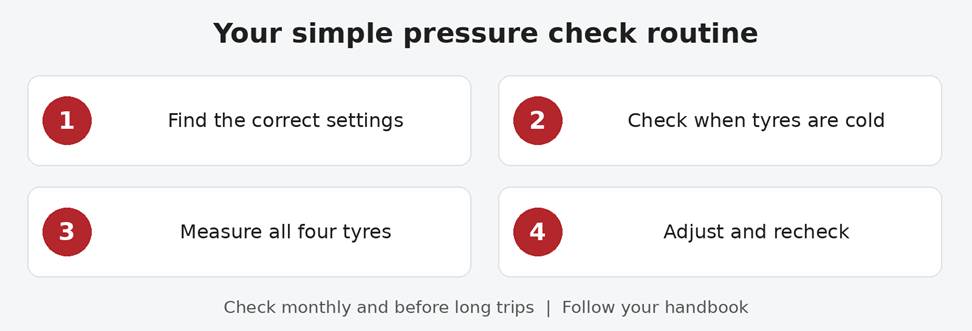
A few regular checks can help you spot pressure loss before it becomes a bigger problem.
Make pressure checks part of looking after your EV
Check at least monthly and before a long journey, or more often if your vehicle manufacturer recommends it. It is also worth checking after a noticeable weather change and before carrying a heavier load.
Use a reliable gauge, make sure it is displaying the right units and check all four tyres. PSI and bar are different units, so a number only makes sense alongside its unit.
Adjust to the recommended cold settings, recheck and replace the valve caps. While you are there, look for cuts, bulges, embedded objects or unusual wear. A tyre does not have to look flat to be underinflated.
Do not keep topping up the same tyre
If one tyre needs air again and again, the useful next step is finding out why. Repeated topping up may hide a leak without dealing with it.
Let us know how quickly the pressure drops and whether you have noticed any damage or warning messages. We can assess the tyre and explain the appropriate next step.
Pressure is one part of getting more from your tyres
Suitable tyres, correct alignment and smooth driving also matter. Gentle acceleration and looking ahead can help avoid unnecessary energy use and tyre wear.
You do not need to turn every journey into an efficiency challenge. Keeping the basics right gives your tyres a better chance of doing their job properly.
Need a hand with your EV tyre pressures
At Tyres 4 U Wirral, we offer free tyre safety checks and pressure checks and adjustments. If you are unsure about the correct settings or have a recurring TPMS warning, we can help you understand what needs checking.
Visit our garage on Kelvin Road, Wallasey, CH44 7JW, or call 0151 638 0906.
For mobile tyre or TPMS enquiries, call or message 07495 893684. We will check the location, availability and any call-out charge before arranging a visit.
A few minutes spent checking your pressures can help you avoid wasting energy and look after the tyres you have already paid for.