
The numbers and letters are more useful than they look
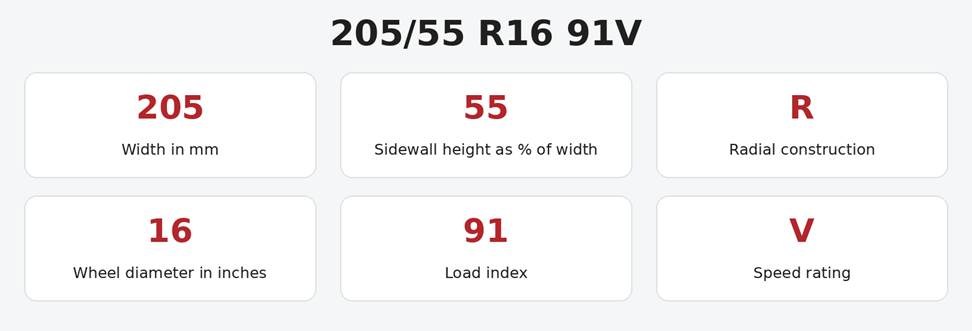
One example tyre code, broken into six useful pieces.
It looks complicated until you know where to start
Take a look at the side of a tyre and you will find a collection of numbers, letters and symbols. It can look like a secret language, but you do not need to learn every marking to understand the useful bits.
The sidewall is the rubber on the side of the tyre, between the wheel rim and the tread. Its markings tell you things such as the tyre’s size, load rating and when it was made.
Knowing where to find them can make ordering tyres much easier. Let us start with a common example: 205/55 R16 91V.
205 tells you the width
The first number is the tyre’s nominal width in millimetres, measured across its section from sidewall to sidewall. In our example, that is 205 mm.
It is a size description, rather than a measurement you need to make yourself with a tape measure.
55 tells you the sidewall proportion
This is the bit that often catches people out. The 55 does not mean the sidewall is 55 mm high. It means its height is 55% of the tyre’s width.
You do not need to do the maths when buying tyres. Just make sure this number is included when you give us the size.
R16 describes the construction and wheel size
R means radial, the construction used by most modern car tyres. It does not stand for radius.
The 16 means the tyre is designed for a 16-inch wheel. It is the wheel diameter, not the diameter of the whole tyre. A tyre marked R17 would need a different wheel.
The last number and letter matter too
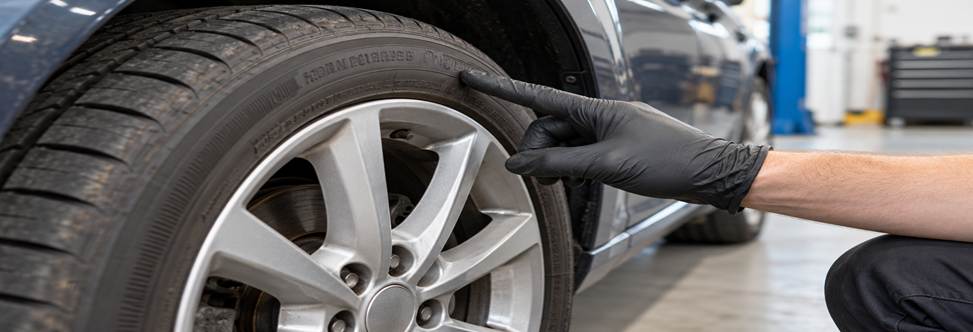
The complete code helps us identify the right specification, not just a tyre that fits the wheel.
91 is the load index
The number after the wheel size tells us how much weight one tyre is rated to carry under specified conditions. It is a code, rather than a weight written directly in kilograms.
In our example, 91 corresponds to 615 kg per tyre. That does not mean you can load the car up to four times that figure. Your vehicle has its own weight limits too.
The practical point is to use a tyre with the correct load rating for the vehicle. Two tyres can have the same size numbers but different load ratings.
V is the speed rating
The final letter describes the tyre’s speed capability under specified conditions. V corresponds to 240 km/h, or about 149 mph.
That is a technical rating, not a suggested driving speed. It still matters when choosing a replacement, even if you never drive anywhere near that speed. We check the appropriate specification for your car rather than choosing a lower rating because you mostly drive locally.
What does XL mean
XL stands for Extra Load. It identifies a tyre designed to carry a higher load than a standard-load tyre of the same size at the appropriate pressure.
It does not mean the tyre is physically extra large, and it does not mean run-flat. If your vehicle needs this specification, it is part of choosing a suitable replacement.
Check more than one tyre
Some cars use different sizes at the front and rear. Do not assume that a photo of one wheel gives the size for all four.
Your handbook and vehicle information can help confirm the approved specification. The markings on the tyres already fitted are useful, but they are not proof that a previous owner fitted the right ones. If anything is unclear, we can help check.
Your tyre has a date code
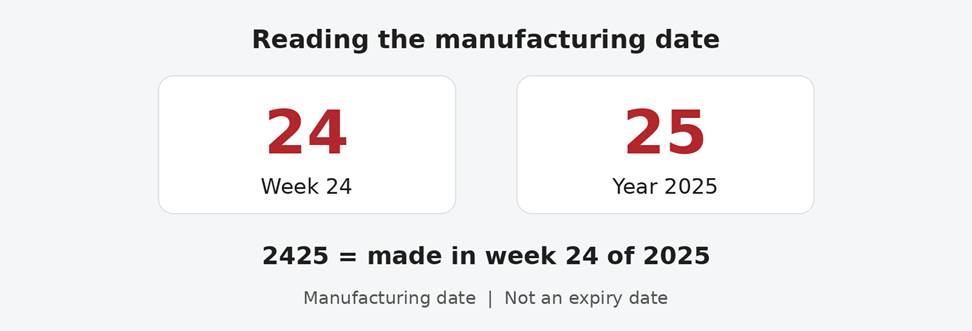
2425 means week 24 of 2025. It is a manufacturing date, not an expiry date.
Four digits tell you when it was made
Look for a four-digit manufacturing date code, often at the end of the identification markings associated with DOT. The first two digits are the week and the last two are the year.
For example, 2425 means the tyre was made in the 24th week of 2025. It does not mean 24 February 2025.
The full date marking may only be on one side of the tyre, so it can face inwards. Do not crawl under a car or put yourself at risk trying to find it. Ask us to check if it is not easily visible.
Does the date tell me when to replace it
The date is useful, but it does not tell the whole story. A tyre’s condition, use, storage and the tyre and vehicle manufacturers’ guidance all matter.
Plenty of tread does not guarantee a tyre is in good condition. Cracking, bulges, damage or a change in how the car feels should be checked. Equally, the date code is not an automatic expiry date stamped onto the tyre.
What are M plus S and the snowflake symbol
M+S means Mud and Snow. On its own, it is not the same as passing the snow-grip test associated with the three-peak mountain snowflake symbol.
That mountain-and-snowflake symbol shows that the tyre meets a defined snow-performance requirement. You may see it on winter tyres and suitable all-season tyres. It does not mean the tyre cannot slip on snow or ice.
The brand and model are useful too
The large name identifies the brand, while another name or code identifies the particular tyre model. If you are asking us to match an existing tyre, include both as well as the full size and rating.
A brand may make several tyres in the same size, with different characteristics.
A few markings that are easy to mix up
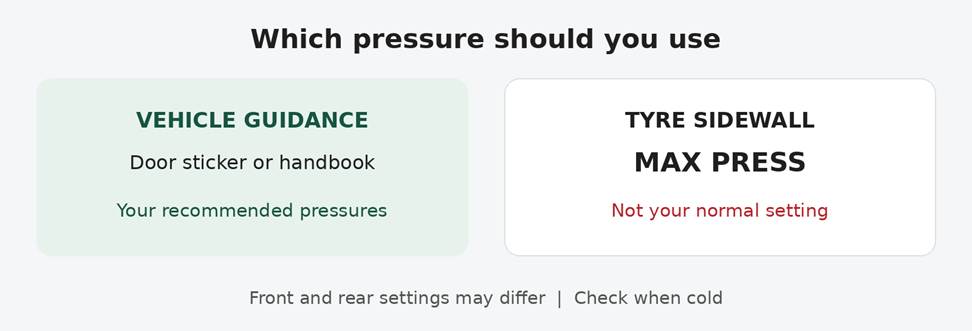
Use your vehicle’s recommended pressure, rather than copying the maximum printed on the tyre.
Maximum pressure is not your normal setting
A pressure marked MAX PRESS on the tyre is not the number to use automatically when you inflate it.
Use the vehicle manufacturer’s recommended pressures, usually found on a door-area sticker, inside the fuel flap or in the handbook. These may differ between front and rear, and between a lightly loaded and fully loaded car. Check pressures when the tyres are cold.
Outside arrows and tubeless
OUTSIDE and INSIDE are fitting instructions on asymmetric tyres. An arrow marked ROTATION shows the intended direction of travel on a directional tyre. Not every tyre has both types of marking.
TUBELESS means the tyre is designed to work without a separate inner tube. It does not mean puncture-proof.
How do I recognise a run flat tyre
Run-flat markings vary between manufacturers. You may see names or codes such as RFT, SSR or ZP. XL on its own does not identify a run-flat tyre.
If you are unsure, ask us to identify it. Run-flat capability has limits, and any continued driving after pressure loss must follow the relevant tyre and vehicle instructions.
The easy way to ask for a tyre quote
Send us a clear photo of the full size code, including the load and speed rating, plus your vehicle registration. Tell us which tyre you need and mention any different front and rear sizes. Include the brand and model if you want to match what is already fitted.
There is no need to memorise the whole sidewall. A clear photo and a quick conversation are often all you need to get started.
Call Tyres 4 U Wirral on 0151 638 0906 or visit Kelvin Road, Wallasey, CH44 7JW. For mobile enquiries, call or message 07495 893684 so we can check location, stock and availability.