
When a simple repair may save you a new tyre
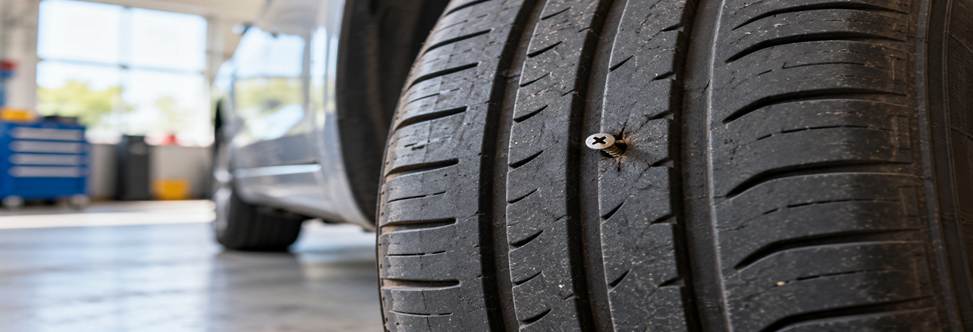
A nail or screw in your tyre does not always mean it needs replacing.
A small hole does not always mean a big bill
Finding a screw in your tyre is frustrating, especially when the tyre still has plenty of tread left. But before you start pricing up a replacement, it is worth finding out whether it can be repaired.
Some punctures can be safely repaired, saving you the cost of a new tyre. Others need a replacement because of where the damage is or what has happened inside.
At Tyres 4 U Wirral, we will check your tyre and explain your options in plain English. If a repair is suitable, there is no need to replace an otherwise usable tyre.
When a repair may be possible
A small puncture in the middle part of the tread is often a good starting point. The tread is the patterned rubber that runs around the tyre and meets the road.
For a normal puncture repair, the hole must be no bigger than 6 mm once prepared for repair. The rest of the tyre must also be in suitable condition, with enough tread remaining and no damage that makes it unsafe.
A nail in the right place may be repairable, but we still need to check the tyre properly before saying yes.
Found a nail or screw
Leave it in place until it can be checked. Removing it yourself may make the air escape more quickly.
If the tyre is flat, do not drive on it to reach us. Stop somewhere safe and arrange help. If you are already safely parked, give us a call and we can discuss the next step.
Why the position of the hole matters
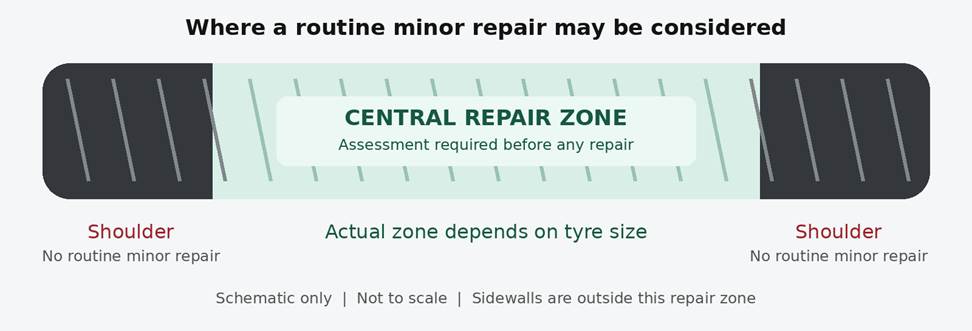
The middle of the tread may be repairable. Damage near the edges needs a different answer.
The middle and the edges do different jobs
A normal puncture repair is only suitable within a defined area in the middle of the tread. We check the correct area for your tyre rather than guessing from where the nail appears to be.
The shoulder is where the tread curves towards the side of the tyre. The sidewall is the rubber on the side, where you will usually see the brand name and tyre size. These areas flex as the wheel turns and are outside the normal puncture repair area.
This means a small hole near the edge can require a new tyre, even when a similar hole nearer the middle could be repaired. It is the position as well as the size that matters.
Why we take the tyre off the wheel
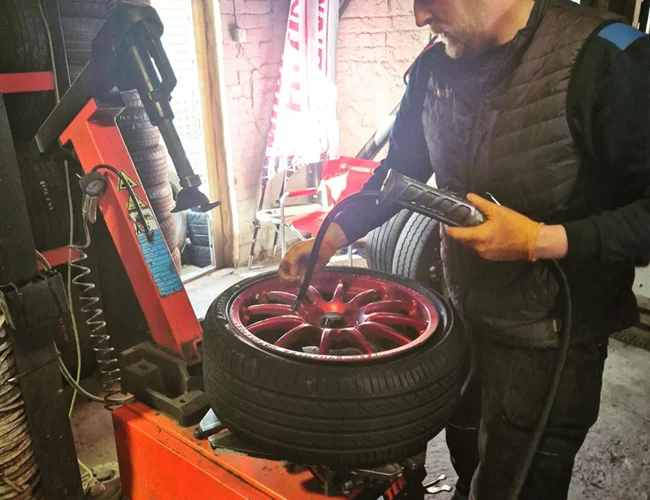
The outside cannot tell us everything. We remove the tyre from the wheel so we can look inside for damage before carrying out a permanent repair.
Driving on a flat or very soft tyre can damage the inside, even if the original puncture is tiny. The tyre may look fairly normal after it has been pumped up again, but that does not mean the damage has gone.
That is why we cannot promise a repair from a photograph alone. A photo can help us give initial advice; the inspection gives us the answer.
When a replacement is the safer option
A replacement may be needed if the hole is too large, the damage is too close to the edge, or the tyre has been damaged by driving flat. Bulges, exposed cords and serious damage also rule out a normal puncture repair.
We check existing repairs and the tyre’s overall condition too. If we cannot repair it safely, we will explain why so you understand the recommendation.
Common questions about punctures
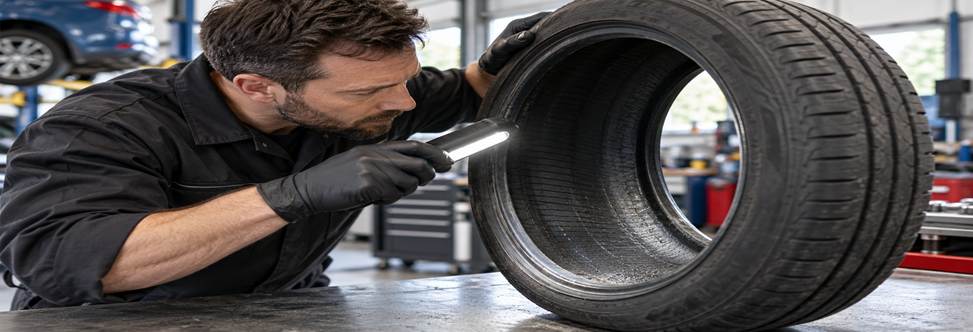
A proper inspection helps us decide whether your tyre can safely stay in use.
What if the tyre only loses air slowly
If you keep topping up the same tyre, have it checked. A slow leak may come from a small puncture, the valve or the seal between the tyre and wheel. It does not automatically mean you need a new tyre.
Finding the cause is better than repeatedly adding air and hoping it goes away.
Can I use the repair kit in my boot
A compressor and sealant kit may help temporarily with certain punctures. Follow the instructions supplied with your kit and car, including the speed, distance and pressure limits. Only use it somewhere safe.
Sealant is not a permanent repair. Tell us if you have used it so we can assess the tyre properly. If the tyre will not hold the required pressure, stop and arrange breakdown assistance.
What about run flat and electric car tyres
Run-flat tyres need an individual assessment. Whether a repair is allowed depends on the tyre manufacturer’s guidance, its condition and whether it has been driven with low or no pressure.
An electric or hybrid car does not automatically need a new tyre after every puncture. The same starting questions apply: where is the damage, how big is it and is the tyre otherwise suitable for repair?
Puncture help from Tyres 4 U Wirral
We assess and repair suitable punctures at our garage on Kelvin Road, Wallasey, CH44 7JW. Mobile puncture repairs are also available across the Wirral, subject to availability and a safe place to work.
Call the garage on 0151 638 0906. For mobile enquiries, call or message 07495 893684. Tell us your location, tyre size if you can check it safely, and whether the tyre has been driven flat. We will confirm availability and any mobile call-out charge.
If the vehicle is in a dangerous position, contact your breakdown provider first.
A puncture does not always mean a new tyre. Let us check it and talk you through the options.