
A better question than which is cheapest
Nobody wants to spend more on tyres than they need to. If three tyres fit the same wheel and look much the same, why pay extra?
The answer is that tyres can differ in ways you cannot judge by looking at them: how they brake in the wet, respond to a sudden steering movement, resist wear and affect running costs. But a higher price is not a guarantee that a tyre will be best at everything.
At Tyres 4 U Wirral, our advice is to compare the actual tyres available for your car, understand the trade-offs and choose the strongest option your budget allows. Here is what is worth checking before you buy.
What budget mid range and premium actually mean
These are useful shop-floor descriptions, rather than an official safety grading system. Budget usually means a lower purchase price. Mid-range covers a broad selection of models competing on price and performance. Premium generally describes established brands with extensive development programmes and a wide choice of specialist products.
Those categories help start a conversation. They cannot tell you how a particular tyre will perform. Even within one brand, a touring tyre, a sports tyre and an all-season tyre have different priorities.
Wet grip deserves your attention
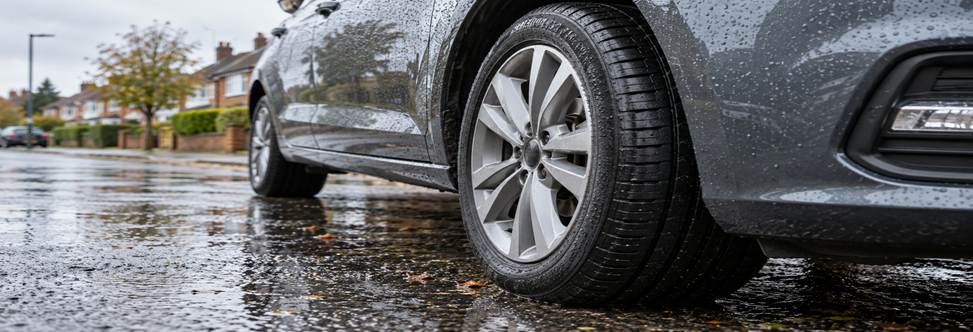
Wet-road performance matters on everyday journeys as well as motorway trips.
The difference may appear when you need to stop
A tyre can feel perfectly acceptable during gentle everyday driving. Its limitations may become clearer when you brake hard on a wet road or need to change direction quickly. That is why independent testing is more useful than appearance or a familiar brand name.
In its 2025 test of 18 summer tyres in size 225/40 R18, ADAC reported that its test car stopped from 80 km/h on wet asphalt in around 28 metres on the best-performing tyre, compared with around 45 metres on the Doublecoin DC100. That is roughly 17 metres of additional braking distance. [1]
This was a comparison of particular models under controlled conditions, not a prediction for every budget tyre or every road. It does show why the cheapest fitted price cannot be the only question.
Does that mean budget tyres are unsafe
It would be misleading to dismiss an entire price category. Equally, meeting the requirements for sale does not mean every tyre delivers the same grip, braking or handling.
A smaller budget is a real constraint. Tell us what you can spend so we can explain the available options, rather than assuming there is only one sensible answer. Ask which model offers the most convincing wet-weather performance within that budget.
Low mileage still includes rainy days
If you mainly drive locally, you may place less value on recovering a higher purchase price through extra mileage. That does not make grip less important. School runs, shopping trips and short commutes still involve junctions, pedestrians and sudden stops.
Your annual mileage should influence the value calculation. It should never be used as a reason to disregard braking performance.
Read the label then look beyond it
Three useful comparisons
Tyre labels provide information on wet grip, rolling resistance and external rolling noise. They are a useful starting point when comparing tyres in the correct size and specification. [2]
Wet grip gives information about braking performance in standardised wet conditions. A stronger wet-grip rating is worth considering, but it does not describe every aspect of driving in rain.
Rolling resistance relates to the energy needed to keep the tyre rolling. A more efficient tyre can help reduce energy use, although the actual saving depends on your vehicle, driving and tyre pressures.
External noise is the sound measured outside the vehicle as it passes. It is not a direct measurement of the noise you will hear inside the cabin. [2]
What the label does not tell you
The label is not a complete scorecard. It does not give you a guaranteed tyre lifespan or an overall rating for steering feel, comfort, dry handling or resistance to aquaplaning. Similar label ratings do not prove two tyres perform identically.
Look for independent tests of the exact model, ideally in your tyre size or a closely comparable specification. Check the individual results as well as the overall position: a tyre can perform strongly in one area and less well in another.
Why a good mid range tyre is worth comparing
In the ACE 2026 summer tyre test in size 225/40 R18, the Falken Azenis FK520 joined Michelin, Continental and Bridgestone models in the top recommendation category. The order changed between individual tests, illustrating why no single result tells the whole story. [3]
This is the useful role of mid-range: another option to investigate, rather than an automatic compromise or an automatic bargain. Compare the current fitted price with the evidence for the particular model.
Make the comparison fair
Ask for the exact brand, model, tyre size, load rating and speed rating. A brand name on its own is not enough. Also compare equivalent products: summer, all-season and winter tyres have different purposes. The best option depends on your vehicle and the conditions you expect to drive in.
Work out value beyond the fitted price
Will premium tyres last longer
Sometimes a higher-priced tyre delivers enough extra usable mileage to justify the difference. Sometimes it does not. We would not promise that every premium tyre lasts longer than every budget tyre.
Wear depends on the specific tyre, vehicle, driving style, pressures, alignment and use. A performance-focused premium tyre may prioritise grip over maximum mileage. A tyre that wears slowly is not automatically the best choice if other performance is weak.
Check what the quote includes
Compare the complete fitted price. Ask whether fitting, balancing, a standard valve where applicable, old-tyre disposal and VAT are included, and whether any TPMS work is extra. That makes it easier to judge the actual difference between your options.
An offer is only useful if it is for a tyre that suits the car and the way you use it.
Choose for your car and your journeys
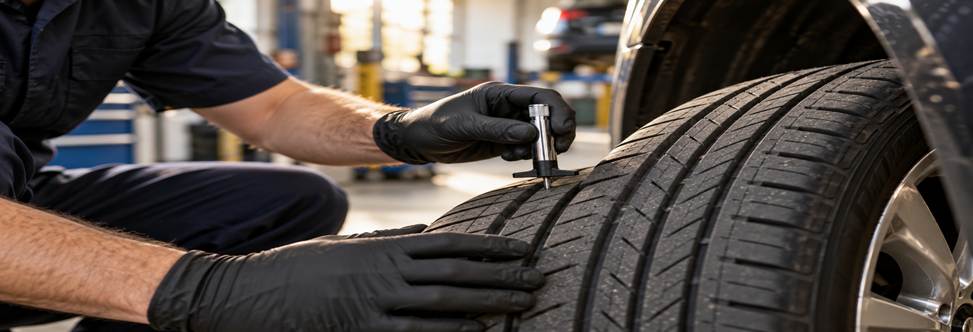
Condition, pressure and correct fitting matter whatever price bracket you choose.
Start with how you actually drive
For frequent motorway journeys, compare wet braking, stability, comfort and evidence on wear. For mainly local use, keep wet grip high on the list and weigh up whether you will use the extra mileage a dearer tyre might offer.
For a heavier car, van, SUV, EV or hybrid, the correct specification matters. We can check the required size, load and speed ratings and discuss suitable options. A tyre should match the vehicle’s requirements, not simply fit the wheel.
If you drive throughout the year in varied conditions, discuss whether an appropriate all-season tyre would suit you. Buying a premium summer tyre does not turn it into a winter tyre.
Protect the tyres you pay for
Whatever you spend, keep pressures at the vehicle manufacturer’s recommendation and check tyre condition regularly. If you notice uneven wear, pulling or a change in steering, have it investigated. Alignment faults can waste usable tread, while balancing addresses wheel vibration; they are different jobs.
Paying more for tyres cannot compensate for neglecting their condition or running them at the wrong pressure.
So are cheap tyres worth it
They can be, when the specific model offers suitable performance at a price you can afford. A well-chosen mid-range tyre may be a stronger buy, while a premium model may justify its extra cost through grip, refinement or usable mileage.
Our advice is simple: ask what the extra money buys you. Compare the evidence, the complete fitted price and your own driving needs. You should understand the recommendation before making the decision.
Talk it through with Tyres 4 U Wirral
We supply budget, mid-range and premium tyres and can explain the options available for your vehicle. If you are unsure whether your current tyres need replacing, call in for a free tyre safety check.
Visit our garage on Kelvin Road, Wallasey, CH44 7JW, or call 0151 638 0906. For mobile tyre fitting across the Wirral, call or message 07495 893684 so we can check stock, location and availability. Any mobile call-out charge will be confirmed as part of your quote.
Sources and further reading
Independent testing and label guidance
[1] ADAC, 2025 summer tyre test, 225/40 R18. Published 25 February 2025. The braking example relates only to the models, size and conditions tested.
[2] Driver and Vehicle Standards Agency, Supply or distribute vehicle tyres: labelling rules. Guidance on wet grip, rolling resistance and external noise.
https://www.gov.uk/guidance/eu-tyre-labelling-regulation-compliance-and-guidance
[3] ACE, 2026 summer tyre test, 225/40 R18. Published 4 February 2026. Results apply to the specific products and test conditions.
https://www.ace.de/ratgeber/rund-ums-auto/reifen/reifentests/sommerreifen-test/sommerreifentest-2026
Illustrations
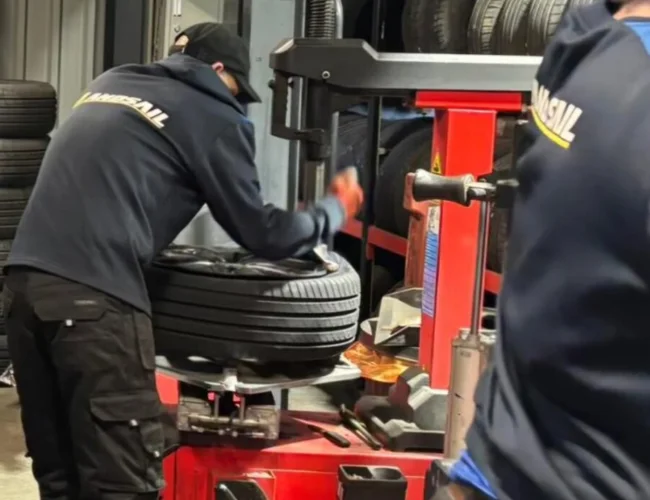
The workshop, wet-road and tread-check images are AI-generated editorial illustrations. They do not depict the Tyres 4 U Wirral premises or staff, or any of the tests cited above.