

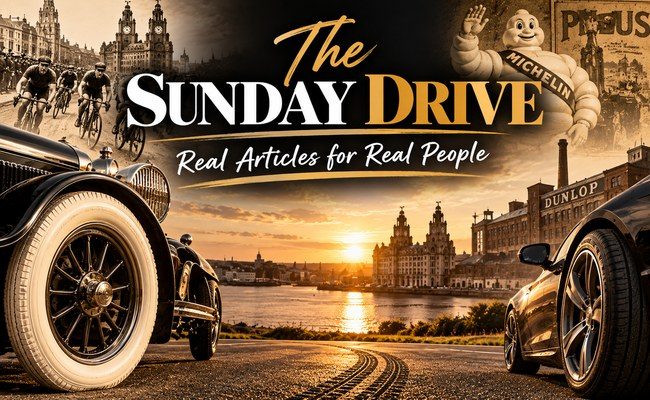
From a Liverpool bicycle race and Speke’s forgotten factory to royal Bentleys, record-breaking speeds and some very unusual wheels.
THE SUNDAY DRIVE | ARTICLE 4 | Sunday 1 November 2026
Real articles for real people.
By Debbie Mearns | Tyres 4 U Wirral
I’ve grown up around tyres. Three generations of my family have fitted, repaired and probably argued about them, so I assumed there wasn’t much left that could surprise me. Then I discovered tyres used to be white.
That fact led me to a Scottish inventor who was 40 years ahead of his time, a Liverpool bicycle race, a factory in Speke that employed thousands and a British car that broke 200 mph nearly a century ago. Somewhere along the way, I also found myself looking at royal Bentleys, presidential limousines and the enormous wheels from Mad Max.
What surprised me most wasn’t the technology. It was how many of these stories involved ordinary people, clever ideas and places close to home. Put the kettle on. We’re taking a look at the world beneath our wheels.
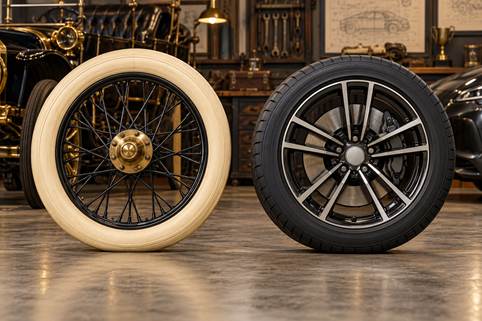
Early pale rubber and modern black tyres • Editorial illustration
First things first. Tyres used to be white?
They really did. Early rubber tyres were often cream, white or pale grey. It explains why the Michelin Man is white: his appearance reflects the tyres of the period. At an exhibition in Lyon in 1894, the Michelin brothers noticed that a stack of tyres resembled a man. The character appeared in advertising in 1898, wearing a monocle and smoking a cigar. One early poster even showed him holding a glass containing nails and broken glass — a rather different approach to tyre advertising!
Carbon black later became an important ingredient because it improved rubber’s wear resistance and durability. Black tyres became standard, although whitewalls remained fashionable, especially on American cars. I rather like them on an old Cadillac; I’m less convinced about keeping them clean through a Wirral winter.
A wheel, a tyre and an idea involving air
Nobody can say exactly who invented the wheel. Evidence of wheeled transport dates to around 3500 BC. Early wheels were wooden, sometimes with metal bands around the edges — bands known as tyres. The word is older than the rubber product we know today. In 1845, a 23-year-old Scottish inventor, Robert William Thomson, patented an air-filled tyre for horse-drawn vehicles. He demonstrated it in London two years later. It worked, but rubber was expensive and manufacturing difficult. The idea was ahead of its time.
Then came John Boyd Dunlop, a Scottish veterinary surgeon living in Belfast. His young son Johnnie’s tricycle was uncomfortable on solid tyres, so Dunlop experimented with an air-filled rubber tube. He patented his version in 1888. Thomson’s earlier patent later came to light, and Dunlop’s patent was invalidated. Why do we remember Dunlop? Timing. Cycling was booming, and his practical tyre arrived when people wanted a smoother, faster ride. Businessman and cycling enthusiast Harvey du Cros recognised its potential and helped turn it into a commercial enterprise. A good invention needs more than a good idea — it needs somebody to get it into the world.
The day Liverpool saw the future of tyres
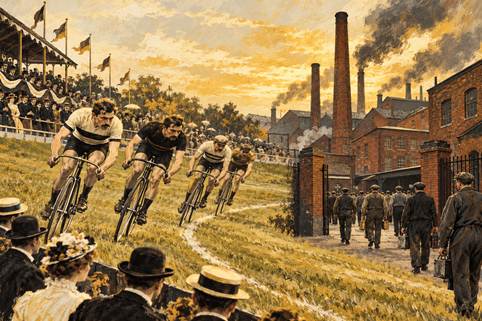
Liverpool cycling and industry • Original illustration, not an archival photograph
In 1889, Belfast cyclist Willie Hume raced on Dunlop’s pneumatic tyres, winning in Belfast before travelling to the Liverpool Police Athletic Society’s sports. He won most of his races there too. Other riders were using solid tyres. Hume turned up on these unfamiliar air-filled ones and started winning. No lengthy technical explanation was needed: people could see the difference.
Local historical accounts also tell of his bicycle being displayed in a shop near Lime Street afterwards, drawing considerable attention. I haven’t been able to confirm every detail of that story, but I hope it’s true. A crowd gathering around a bicycle because of its tyres! Liverpool was seeing an important development in transport at first hand. And the city’s connection with Dunlop didn’t end with that race.
From racing in Liverpool to making tyres in Speke
Liverpool later became home to a major Dunlop tyre factory in Speke, employing thousands. For many families, Dunlop wasn’t simply a name on a tyre: it was a workplace, a wage packet and a trade. The tyre factory closed in 1979. In a House of Commons debate on 3 April 1980, Liverpool MP David Alton referred to 2,400 jobs lost at the plant the previous year. Behind that figure were families and working lives suddenly changed.
The golf-ball factory nobody expects
What I hadn’t realised was that Dunlop also operated a golf-ball factory on the site. The smaller operation relied on the tyre plant for steam, water, power and engineering services. Once the tyre factory closed, the golf-ball operation faced enormous difficulties. Workers and local management tried to keep production going. In the House of Commons on 18 April 1980, MP Malcolm Thornton read a letter from the workforce describing how they installed boilers in the middle of the night and worked in cold, damp conditions, hoping for a new factory. In late March they had been told the plant would close that July, with around 230 jobs lost.
It was the determination in that account that stayed with me. Factory closures are often described through figures, but to the people involved they were about livelihoods, communities and futures.
Speke was a heavy blow, not the end of the story
In the April 1980 debate, Alton quoted Dunlop’s chairman saying the company still had four factories in Liverpool. Two weeks later, a minister told MPs Dunlop still employed around 2,000 people on Merseyside. The figures varied depending on who was counting, but the picture is the same: Speke was a heavy blow, not the end of Dunlop’s local story.
The wider industry also had major roots in Belfast and Birmingham, home of the famous Fort Dunlop. Yet it’s the Speke story I keep coming back to. Here on the Wirral, our family is still involved in tyres three generations later. I find it fascinating that so many local families once helped make them.
From Liverpool’s bicycle races to more than 200 mph
In 1927, only 38 years after Hume’s Liverpool races, a British-built car became the first to exceed 200 mph. Henry Segrave drove the Sunbeam 1000 HP at Daytona Beach, achieving an average of 203.79 mph on 29 March. The Wolverhampton-built car, nicknamed “The Slug”, had two huge aircraft engines and specially prepared Dunlop tyres. Fresh tyres were fitted between record runs as a precaution. You can build an astonishing engine, but at that speed the tyres have an equally important job.
There’s a modern connection too: the National Motor Museum has planned a low-speed return to Daytona for the car’s centenary on 29 March 2027. It’s a lovely piece of motoring history to look forward to — and emphatically not another 200 mph attempt.
Tyres fit for a king — and a president
Two specially built Bentley State Limousines were created for Queen Elizabeth II’s Golden Jubilee in 2002 and continue in royal service under King Charles III. Their unusual weight, ceremonial use and protective design place demands on their tyres very different from those of an everyday car. Some secondary accounts describe Kevlar-reinforced tyres, although I haven’t found a detailed official specification confirming that detail. Reinforced, run-flat and bulletproof are not interchangeable terms, and precise security features aren’t public.
Across the Atlantic, the American president’s limousine — The Beast — is publicly reported to use specialist run-flat arrangements intended to preserve mobility after tyre damage. That doesn’t mean its tyres are indestructible. It means keeping the vehicle moving is part of the design challenge. We’ll save the wider royal motoring story for another Sunday Drive.
Mad Max, enormous wheels and soft ground
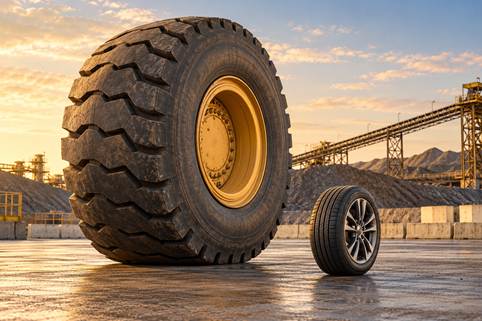
Different loads, different tyres • Editorial illustration
Many vehicles in Mad Max: Fury Road were actually built and driven. Australia’s National Motor Museum records around 150 vehicles created for the film, including Big Foot, a modified Second World War-era Fargo pickup with 66-inch wheels — roughly 1.68 metres across. I can imagine one arriving at Tyres 4 U Wirral. Matt would probably ask who was going to fit it!
But large tyres have a serious purpose too. Some vehicles travelling on soft sand or deep snow use large, low-pressure tyres to spread their weight and reduce sinking. Mining trucks use enormous specialist tyres for heavy loads. Different terrain, different weights, different engineering. The biggest tyre isn’t automatically the best; it’s the one designed for the job.
Liverpool’s Duckmarines and a clever tyre trick
Remember the yellow Duckmarine tour vehicles around Liverpool’s waterfront? They were based on the wartime DUKW, a six-wheeled amphibious vehicle. Its original design incorporated central tyre inflation: the driver could adjust tyre pressures from the cab, using lower pressures for soft ground and higher ones for firmer roads. It was a practical solution long before modern dashboard tyre-pressure displays became commonplace. The same principle remains useful on specialist military, agricultural and off-road vehicles.
The discarded car tyre in Salthouse Dock
The Liverpool Duckmarine story also has a serious chapter. Two vehicles sank in Salthouse Dock in 2013. The first, in March, had nobody on board. In June, Wacker Quacker 1 sank with 31 passengers and two crew. The Marine Accident Investigation Branch found its propeller had been fouled by a discarded car tyre, tearing two holes in the hull. Everyone was rescued without serious injury, helped by crews of nearby narrowboats. Investigators also found insufficient reserve buoyancy and poor maintenance. The company later entered administration and its road licence was withdrawn.
The incident wasn’t caused by the central tyre-inflation system. It’s a reminder that clever engineering still depends on sound maintenance — and it raises another question: what really happens to old tyres after they leave our cars? We’ll explore that in a future Sunday Drive.
Can a tyre ever be puncture-proof?
One interesting answer comes from off-road motorcycle racing. Michelin’s Bib Mousse, used since the early 1980s, is a foam insert that replaces the conventional air-filled tube. It cannot suffer an ordinary loss-of-air puncture, but the tyre can still wear or be damaged, and the system has limitations. Importantly, Michelin says Bib Mousse is for off-road use and is not road-legal. It isn’t a solution for the family car. We’ve already explored newer airless concepts in our earlier 2040 article; what interests me here is how long inventors have been trying to solve the same question: how do we stop tyre damage ending a journey?
Three questions worth asking about your own tyres
1. What does my vehicle weigh and carry? A small city car and a heavily loaded SUV need tyres with appropriate size, construction and load ratings.
2. Where do I mostly drive? Town journeys, motorways and rural roads can create different priorities when choosing between suitable tyres.
3. What happens if I get a puncture? Does your car have a spare, repair kit or run-flat tyres? Would you know what to do? Check before you need the answer.
Regular tyre-pressure and condition checks are still among the simplest ways to avoid unnecessary trouble. Not glamorous, perhaps, but neither is being stranded at the roadside.
So, what have I learned?
I didn’t know tyres used to be white. I hadn’t appreciated that the pneumatic tyre was patented decades before Dunlop’s famous version. And I certainly hadn’t realised how much Liverpool featured in the story. First, Willie Hume showed what pneumatic tyres could do in competition. Later, generations of local people helped manufacture them at Speke. That’s my favourite discovery, because tyre history isn’t only about inventors, racing drivers and famous brands. It’s about the workers, the families and the communities connected to the industry.
From pale nineteenth-century tyres to the Sunbeam’s speed record and the enormous wheels of Mad Max, the technology has come a long way. But the basic job remains the same: carry the vehicle, grip the surface and help us get where we’re going safely. As for me, I think I’ll stick with four ordinary black tyres. Although I wouldn’t mind seeing a beautiful old Cadillac arrive at the garage wearing whitewalls. That would make a change!
Over to you
Do you remember Dunlop’s factory in Speke, or know somebody who worked there? I’d love to hear your family memories and see any photographs connected with the site. You can reply in the comments on our Facebook or Instagram posts, or email hello@tyres4uwirral.co.uk. We’ll ask permission before sharing anyone’s memories or pictures in a future article.
The Sunday Drive — Real Articles for Real People | Written by Debbie, co-owner of Tyres 4 U Wirral | Cars • Costs • Safety • The Future
Sources and further reading
- Michelin — history of Bibendum and Michelin Bib Mousse (off-road only).
- UK Parliament, Hansard, 3 April 1980 — International Sports Company Limited, Merseyside (David Alton).
- UK Parliament, Hansard, 18 April 1980 — Dunlop Golf Ball Factory, Speke (Malcolm Thornton and workforce letter).
- National Motor Museum, Beaulieu — Sunbeam 1000 HP and 2027 centenary programme.
- National Motor Museum, Australia — Mad Max: Fury Road vehicles.
- Marine Accident Investigation Branch — Wacker Quacker 1, Report 32/2014.
- Historical accounts of Thomson, Dunlop, Harvey du Cros and Willie Hume’s 1889 Liverpool races.
Editorial note: Some minor details of nineteenth-century accounts remain uncertain; protected state-vehicle security specifications are not public. Illustrations in this document are original editorial artwork, not historical photographs.