


Electric Cars: Are We So Busy Taking Sides That We’re Missing the Bigger Picture?
One diamond. Many different sides. Is the electric vehicle debate really that black and white?
THE SUNDAY DRIVE | ARTICLE 3 | Sunday 25 October 2026
Real articles for real people.
By Debbie Mearns | Tyres 4 U Wirral
I’m going to start with a confession. My mobile phone battery and I have a rather complicated relationship. I can leave the house fully charged, with a cable and portable charger, yet the minute I really need to make a call, that little red battery symbol appears. It’s almost as though it knows!
So when someone mentions electric cars, my first thought isn’t about the environment or technology. It’s: what happens if I run out of charge when I really need to get somewhere?
I appreciate an electric car isn’t an oversized mobile phone. But with three children, a dog, a business and the usual family taxi duties, reliability matters. I’ve always pictured a hybrid as my next car: a little electric driving, with petrol there for reassurance. Am I being sensible, or just sticking with what I know?
The EV debate feels like choosing sides in a football match. You’re either cheering for electric cars or apparently stuck in the past. Surely there’s more to it? I think it’s like a diamond: turn it slightly and you see a different side. I’ve looked at the research, the arguments, what is happening here on the Wirral, and asked Matt what he sees in our garage. A few things surprised me.
One diamond. Two completely different drivers.
Imagine two neighbours. One has a driveway, a cheap overnight tariff and an EV they love. The other lives in a terraced house, parks wherever there’s room and relies on public charging. They could travel the same distance and have completely different experiences. Who’s right? Possibly both. Perhaps the better question isn’t whether EVs are good or bad, but good for whom?
First, a quick lesson in hybrids
Before researching this, I thought I understood hybrids. It turns out there are more varieties than I realised.
| Vehicle | What it means |
| Fully electric (BEV) | Battery only; plug in to charge |
| Full hybrid (HEV) | Petrol engine and electric motor; no plug needed |
| Plug-in hybrid (PHEV) | Petrol engine and rechargeable larger battery |
| Mild hybrid (MHEV) | Engine with electrical assistance; cannot normally drive electrically alone |
A plug-in hybrid can be useful for short trips if you actually charge it. If you never plug it in, you’re carrying the extra equipment without getting the full benefit. Even saying ‘I’ll buy a hybrid’ doesn’t tell me which one suits my life.
Why is the world moving at different speeds?
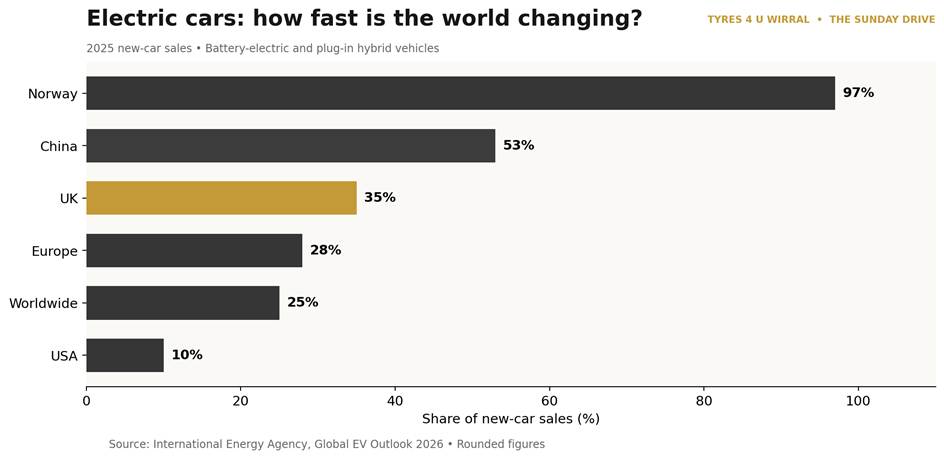
Now here’s a number that made me look twice: Norway’s electric and plug-in hybrid share of new-car sales in 2025 was around 97%. Practically every new car! China was around 53%, the UK 35%, Europe 28%, the world 25% and the USA 10%. These aren’t shares of all cars already on the road; they’re new sales.
Norway has spent years on incentives and infrastructure, supported by hydropower. China has combined manufacturing scale with competitive pricing; the IEA estimated around 70% of battery-electric cars sold there in 2025 were cheaper than the average conventional car. Thailand is another market where prices are getting more competitive. It made me wonder: is the question less ‘Do people like EVs?’ and more ‘Can they afford one and use it conveniently?’
But what’s actually happening on our own roads?
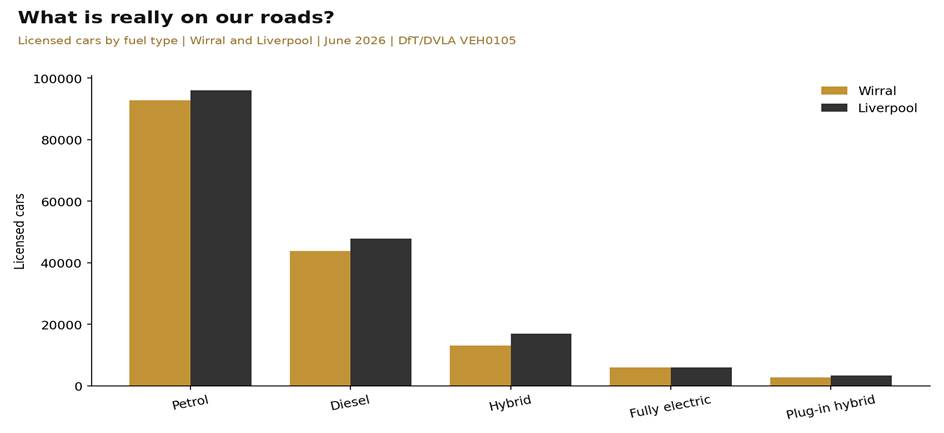
With all the talk of an electric revolution, you’d be forgiven for thinking everybody was quietly switching. So I looked at the licensed cars in Wirral and Liverpool at the end of June 2026. And here’s a surprise: Wirral had 5,970 fully electric cars, Liverpool 5,991. Just 21 cars apart!
| Fuel type | Wirral | Liverpool |
| Petrol | 92,728 | 96,052 |
| Diesel | 43,815 | 47,765 |
| Hybrid | 13,093 | 17,021 |
| Fully electric | 5,970 | 5,991 |
| Plug-in hybrid | 2,806 | 3,387 |
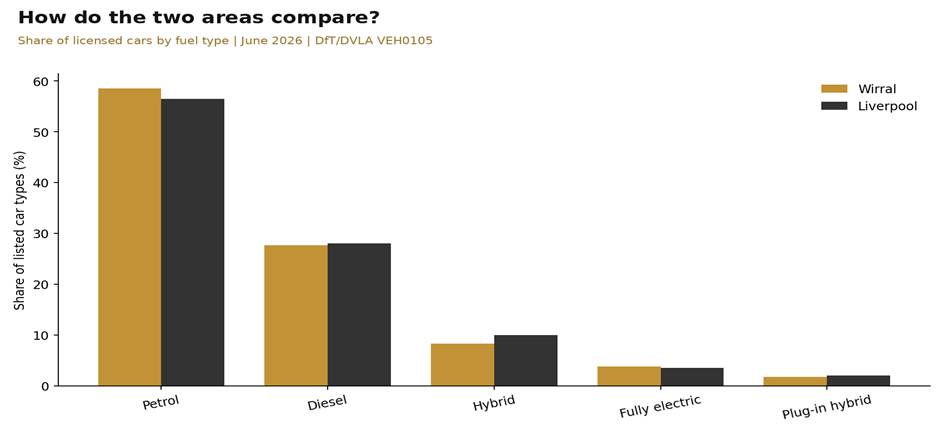
Petrol and diesel still make up roughly 86% of the listed cars on Wirral and 84% in Liverpool. Fully electric cars account for around 3.8% and 3.5% respectively — a fairer comparison than counts alone. Here’s the surprising bit: Wirral has 5,970 fully electric cars and Liverpool 5,991, just 21 apart. So petrol and diesel are still doing most school runs, while hybrids and EVs are steadily gaining ground. Perhaps change is happening one car replacement at a time, not overnight.
These are vehicles registered to keepers locally, not a count of every car physically driving our roads. And the number already on the road is different from the proportion of brand-new cars sold this year. Both figures matter.
Is electric driving becoming a class issue?
A family with a driveway might charge cheaply overnight. A family in a terraced house could face higher public prices, more planning and a late-night walk to move the car. Same technology; very different experience. There’s even a tax difference: public charging generally carries 20% VAT, while qualifying domestic electricity in Great Britain is temporarily zero-rated from 1 October 2026 until 31 March 2027. That’s another reason why the driveway question matters.
And there’s another side to this. Not everyone can afford to replace a perfectly good car, either. If you’ve got a reliable petrol or diesel car that does everything you need, why should you feel pressured to spend thousands replacing it? It’s easy to say everyone should switch when you’re not the one paying the bills. I want cleaner transport as much as anyone, but surely the change has to be affordable and realistic for ordinary families too.
What does it cost to drive 100 miles?
Here’s where I really started paying attention. An electric car can be much cheaper to power — but where you charge changes everything. These are example costs, not promises from a supplier.
| Fuel or charging | Example rate | 100 miles |
| Home, off-peak | 7p/kWh | £1.96 |
| Home, standard | 26.32p/kWh | £7.37 |
| Public slow/fast | 55p/kWh | £15.40 |
| Public rapid | 77p/kWh | £21.56 |
| Petrol at 45mpg | 174.1p/litre | £17.59 |
Less than £2 for 100 miles on cheap home electricity? I’d be interested. Very interested! At these example prices, even public slow or fast charging (£15.40) is slightly cheaper than our petrol example (£17.59). But rapid charging (£21.56) is dearer. So the answer depends on where you plug in, not simply which car you drive. And that’s before insurance, depreciation and tyres enter the conversation.
Are we being left behind in the North West?
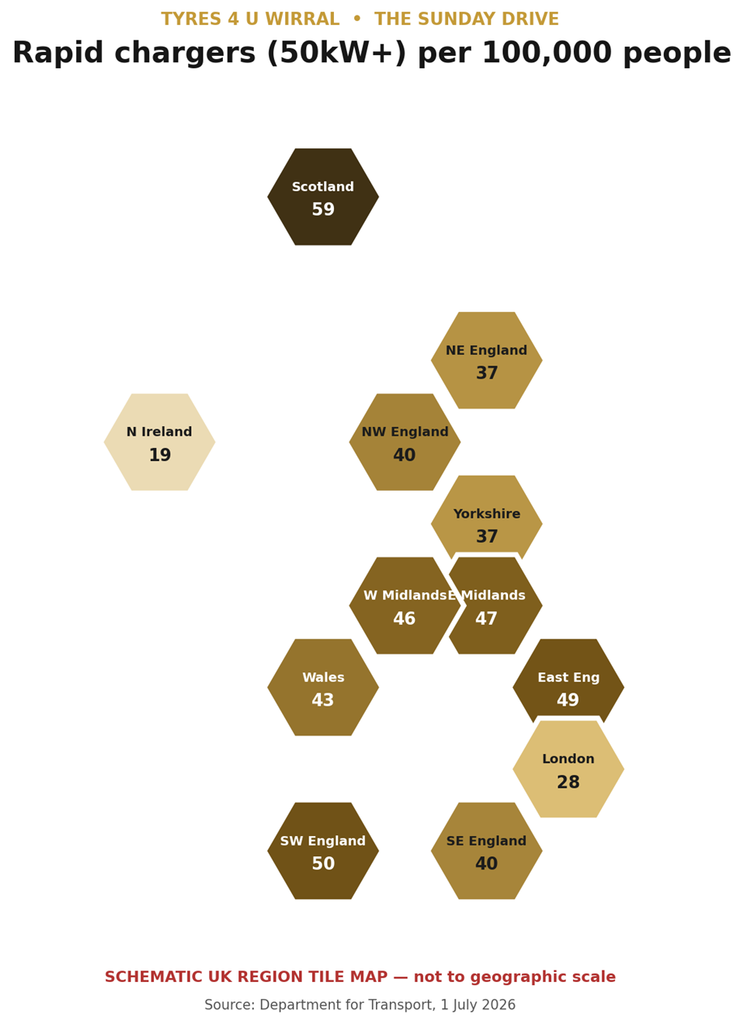
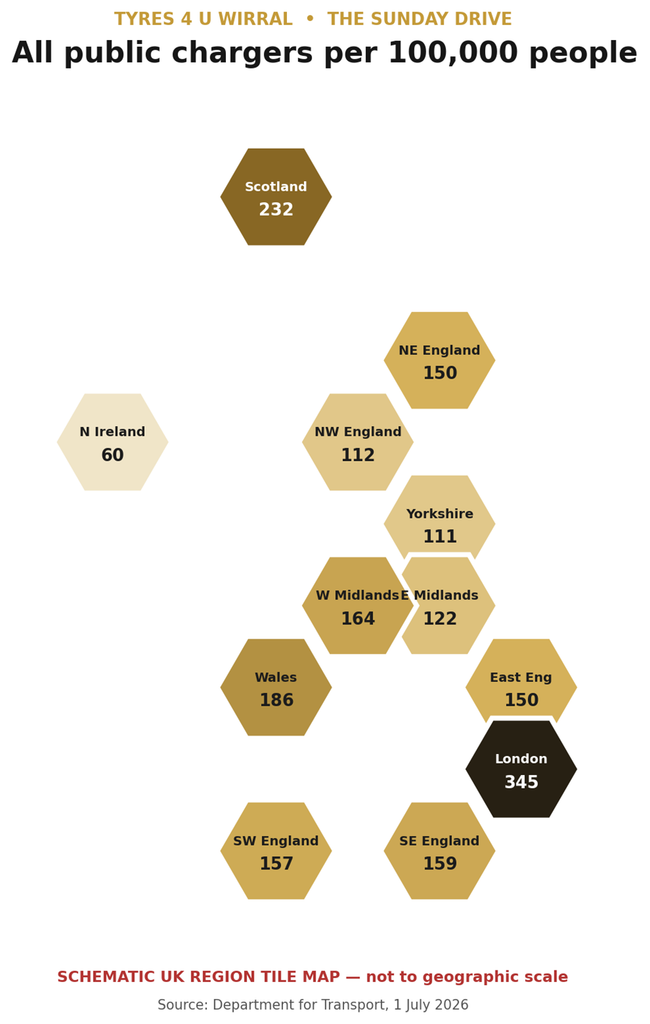
The UK had 121,171 public chargers in July 2026, including 28,887 rapid or faster. So are we being left behind in the North West? For all public chargers, yes, we’re below the UK average: 112 per 100,000 residents against 175 nationally. But rapid charging is much closer: 40 against 42. London has around 345 chargers per 100,000, yet only about 28 are rapid. Different types of chargers meet different needs — a big total doesn’t necessarily mean an easier journey.
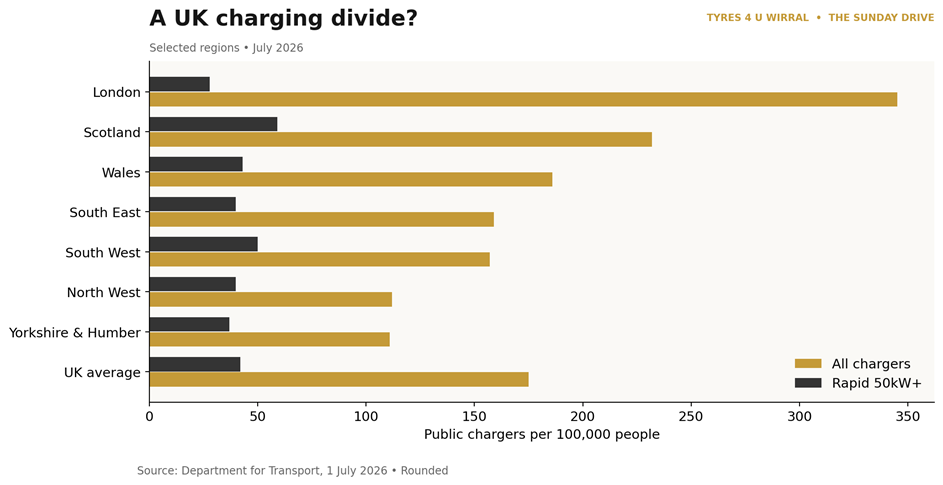
These maps show how unevenly public charging is spread around the UK. The darker the shade, the more chargers per 100,000 people. Compare the two and you’ll notice that regions with plenty of chargers overall aren’t always the same places with the most rapid charging. They’re simplified regional illustrations, so they tell us about broad differences, not whether there’s a working charger on your street.
From Liverpool’s docks to Birkenhead’s trams
A fun fact I loved: Liverpool opened the world’s first enclosed commercial wet dock in 1715; the Liverpool–Manchester Railway transformed travel in 1830; and Birkenhead opened Britain’s first street tramway in 1860. It was horse-drawn at first, then electrified in 1901. So electric transport around here is hardly a new idea!
Today, Gillmoss depot supports 108 battery-electric buses serving Liverpool and Knowsley. Liverpool has also reported hundreds of on-street chargers, including lamppost charging. But what about the two sides of the Mersey?
| July 2026 | Wirral | Liverpool |
| All public chargers | 234 | 996 |
| Rapid or faster | 80 | 86 |
| All per 100,000 | 71 | 196 |
| Rapid per 100,000 | 24 | 17 |
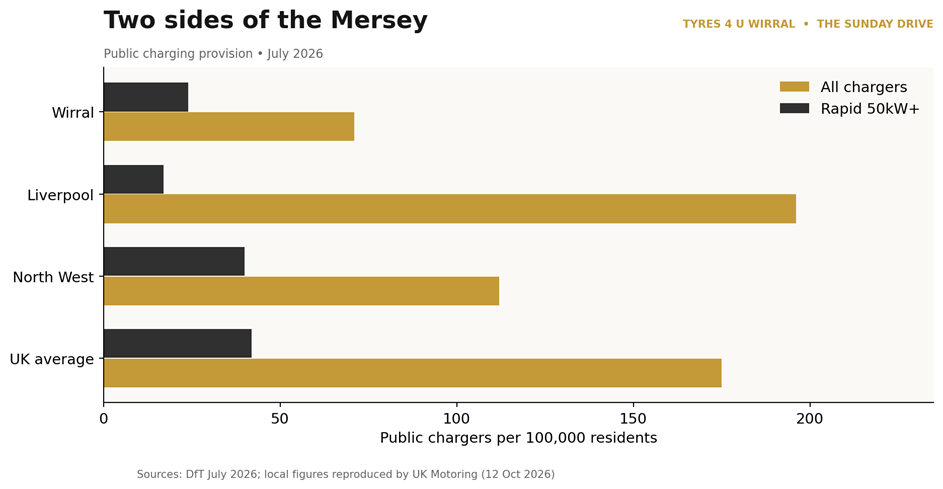
Liverpool has more than four times as many public chargers overall, yet Wirral has 80 rapid chargers against Liverpool’s 86. Per resident, Wirral actually has more rapid chargers. But here’s the more important local gap: Wirral has only 71 public chargers per 100,000 residents, compared with 112 across the North West and 175 across the UK. That doesn’t mean every local driver struggles — home chargers aren’t included — but it shows why promises about future provision need to turn into working chargers.
Wirral Council aims to introduce 1,580 additional standard or fast chargepoints by 2030. Encouraging — but planned isn’t installed, and installed isn’t always commissioned and available. A charger promised for 2029 won’t help you on Tuesday evening. The approximately £9.6 million government funding is for the wider Liverpool City Region, not Wirral alone.
The case for electric cars — and it is a strong one
Cheap home charging can be a huge saving. EVs are often quiet and smooth to drive, produce no exhaust emissions while moving and have fewer conventional engine components. A 2025 ICCT European study estimated battery-electric cars sold in the EU produce about 73% fewer lifetime greenhouse gas emissions than comparable petrol cars. That’s a serious advantage, not just a clever advertising line.
But the case against deserves a fair hearing
Public rapid charging can be expensive. Upfront price, depreciation and insurance can bite. Cold weather, motorways and towing affect range. Street parking can make charging awkward. And EVs still need tyres, brakes, suspension checks and repairs. Pointing out these drawbacks doesn’t make someone anti-electric; it makes them a careful buyer.
What does national research say about EV tyres?
In September 2026, research commissioned by the British Vehicle Rental and Leasing Association (BVRLA) and carried out by New AutoMotive analysed 47.4 million DVSA MOT tests. EVs recorded around 1.8 times as many tyre defects as petrol cars across the dataset. That’s important, but it does NOT mean tyres wear out 1.8 times faster: defects and tyre lifespan are different measures. The problem was particularly pronounced among some earlier EVs adapted from petrol or diesel platforms.
Here’s the twist: among vehicles aged three to eight years with 90,000–120,000 miles, 16.5% of EVs failed their MOT versus 22.1% of petrol cars. Researchers also found no general EV suspension-weight penalty. And EVs covered higher median annual mileage than petrol cars at every age examined, which may partly influence raw defect comparisons — although the report doesn’t say that explains the tyre finding. The point? There’s more to this story than a headline about heavy batteries.
What does Matt actually see in our garage?
I couldn’t write this without asking Matt. I’ve been reading reports; he’s been working on the vehicles. He says we’re seeing noticeably more EVs and hybrids than last year, from a wider variety of manufacturers.
From vehicles we’ve worked on, Matt estimates some EV owners need replacement tyres about one-and-a-half times as quickly as drivers of comparable conventional cars, especially where alignment is out. That’s his workshop observation, not a national average. He points first to instant acceleration and how people drive. I suspect weight, pressure, alignment and tyre choice matter too. And you certainly don’t need an EV to wear tyres quickly if you’re enthusiastic with the accelerator!
Many EVs arriving at our garage have particular tyre requirements, Matt says, while more of the hybrids we’ve seen use conventional options. That doesn’t mean every EV needs a tyre marketed as ‘EV-specific’: the manufacturer’s approved size, load and speed ratings come first.
Lifting can also require additional care. Matt mentioned our Tesla lifting pucks and correct manufacturer lifting points, especially around underbody batteries and high-voltage components. Routine tyre fitting doesn’t usually involve touching the high-voltage system, but safe procedures still matter.
His biggest advice made me smile: check the cost of replacement tyres before buying the car. You could spend weeks comparing electricity tariffs and battery range, then get a shock when you need four tyres! And that advice goes for petrol and diesel cars too.
Are EVs really better for the environment?
Battery manufacturing requires energy and materials; mining can have genuine environmental and social impacts. Those concerns shouldn’t be waved away. But neither should we ignore years of driving. The ICCT’s EU study estimated EV manufacturing emissions around 40% higher than petrol, offset after roughly 17,000km, with substantially lower lifetime emissions overall. Its estimates for conventional and plug-in hybrids were around 20% and 30% lower than petrol respectively. These are modelled European comparisons, not guarantees for every car.
What about batteries and running out of charge?
Back to my phone! EV batteries gradually lose capacity, but they’re engineered differently. Geotab’s 2026 study of more than 22,700 connected EVs reported average degradation of about 2.3% a year. Individual results vary with battery design, climate and charging. I’d ask about battery health and warranty on a used EV.
And what about winter? I’ve heard people say an electric car loses half its battery the moment the frost arrives. Well, there’s a grain of truth in the concern, but it isn’t quite that dramatic or that simple. Cold batteries work less efficiently, and heating the cabin and battery uses energy. In a controlled 2026 AAA test at about minus 7°C, three EVs averaged a 39% reduction in driving range compared with mild weather. That’s a serious difference, but it’s not a prediction for every car or a typical Wirral morning! Some models do much better. The important distinction is that winter range loss is largely temporary — it doesn’t mean the battery has permanently lost that capacity. Warming the car while it’s plugged in (called preconditioning) can help, and rapid charging may be slower until the battery warms up. So yes, winter matters. But no, your battery doesn’t simply disappear because you’ve had to scrape the windscreen.
Then I realised something: I don’t normally run my petrol tank empty and hope for the best. I plan to refuel. EV owners plan charging too. The difference is whether that fits your routine. For one driver, plugging in at home is easier than visiting a petrol station; for another, finding a working public charger is another chore.
Five EV claims worth questioning
| What people say | What the evidence suggests |
| Batteries die after eight years | Eight years is a common warranty period, not an expiry date |
| EVs are always cheaper | Charging, insurance, purchase price and depreciation matter |
| EVs are worse for the planet | Manufacturing has impacts; lifecycle research generally favours EVs |
| EVs destroy tyres | Wear varies with alignment, tyre specification and driving style |
| There are chargers everywhere | Availability, speed and reliability vary by location |
| “Cold weather ruins the battery.” | Winter can substantially reduce usable driving range and slow charging, especially in extreme cold. Much of the loss is temporary, not permanent battery damage. |
| “An EV cannot be charged in the rain.” | Modern charging equipment is designed for outdoor use with protective systems. Follow the manufacturer’s instructions and never use damaged equipment. |
| “You must replace a good petrol car immediately.” | There is no requirement to scrap an existing petrol or diesel car in 2030. Keeping a reliable car may be the most practical financial choice for many households. |
What is the government actually planning?
The stated UK policy is to end sales of new purely petrol and diesel cars in 2030, with qualifying full and plug-in hybrids permitted until 2035; mild hybrids aren’t included in that exemption. Existing petrol and diesel cars aren’t being banned from the road. The consultation reviewing the Zero Emission Vehicle Mandate, including the 2030 target, closed on 23 October 2026. Consultation proposals are not automatically changes to the law.
Eligible new BEVs can qualify for grants of £1,500 or £3,750, subject to conditions. Government has also announced additional mileage-based taxation from April 2028: initially 3p per mile for BEVs and 1.5p for PHEVs. At 10,000 miles that’s £300 or £150, subject to final rules. The financial picture keeps evolving.
Are hybrids the sensible middle ground?
For me, perhaps. A full hybrid doesn’t need plugging in. A plug-in hybrid could suit shorter trips if I actually charge it. But someone with cheap home electricity and predictable journeys may be better off fully electric. And someone with a good petrol car may reasonably keep it. Neither side automatically wins.
What about people who simply cannot afford to change?
Not everybody is choosing between shiny new models. Some people are trying to keep the car they own safely on the road for work, school and caring responsibilities. Cleaner transport matters, but so do household budgets. Affordable used vehicles, practical charging and sensible repair costs must be part of the conversation.
So, has writing this changed my mind?
Yes — but perhaps not as you’d expect. I still think my next car will probably be a hybrid. Not because I’m against EVs. Cheap home charging surprised me; the battery evidence reassured me; the environmental case was stronger than some arguments I’d heard. But I don’t want to rush an expensive decision that has to fit my family.
Norway shows what long-term planning can achieve. China shows what affordability can change. Wirral and Liverpool show that the transition is real but more gradual than the headlines suggest. Matt reminds me that whatever powers a car, it still needs looking after. Maybe the question isn’t whether EVs are good or bad. Maybe it’s whether we’re prepared to look at every side before deciding.
And as for me? I’ll probably still keep a charging cable in my handbag. Just in case!
THE SUNDAY DRIVE — REAL ARTICLES FOR REAL PEOPLE
Written by Debbie, co-owner of Tyres 4 U Wirral. Real questions, different perspectives and useful information to help ordinary motorists make their own decisions.
Over to you: would your next car be petrol, diesel, hybrid or fully electric? What matters most — cost, convenience, the environment or confidence in something new?
Sources, definitions and chart notes
Figures refer to different populations and dates and should not be compared as if they were identical measures.
Global new-car sales: IEA Global EV Outlook 2026; rounded 2025 shares for battery-electric plus plug-in hybrid new-car sales, excluding conventional hybrids. Regional definitions and reporting methods vary.
Local fuel-mix charts — Source: Department for Transport/DVLA, VEH0105 licensed vehicles by local authority, body type and fuel type (April–June 2026 release). Values shown were cross-checked for arithmetic but could not be independently reconciled against the downloadable primary table in this edition. Figures are therefore indicative pending direct dataset reconciliation. Percentages use the five displayed categories; small other-fuel categories are excluded. Registered-keeper location is not a count of traffic on local roads.
Energy-cost comparison — EV assumes 28 kWh purchased from the charger per 100 miles, including charging losses; petrol assumes 45 imperial mpg. The 174.1p/litre E10 unleaded price was reported for 20 October 2026 by Car Comparison’s Fuel Finder-derived UK Pump Price Index (carcomparison.co.uk/fuel-price-index). Other Fuel Finder-based indices report slightly different averages because of methodology and reporting stations. Home off-peak 7p/kWh, public slow/fast 55p/kWh and rapid 77p/kWh are illustrative tariffs. Qualifying domestic electricity is zero-rated for VAT in Great Britain until 31 March 2027; public charging normally carries 20% VAT.
UK regional charging charts and maps: DfT Public Electric Vehicle Charging Infrastructure Statistics, 1 July 2026. Chargers per 100,000 residents; rapid means 50kW+. Regional map graphics are schematic and not exact geographic administrative boundaries. Charger counts are public devices and exclude home chargers.
Wirral–Liverpool charging — DfT EVCI0102, public EV chargers by local authority, 1 July 2026, is the relevant primary table. Published DfT-attributed local figures used here are Wirral 234 all / 80 rapid and Liverpool 996 all / 86 rapid; rates per 100,000 are 71 / 24 and 196 / 17 respectively. The original downloadable ODS could not be independently read in this review, so the precise borough rows remain provisionally attributed rather than described as independently verified. Rapid means 50kW+.
Charging plans: Wirral Council target of 1,580 additional standard/fast chargepoints by 2030 is planned delivery, not currently installed or operational infrastructure. Approximately £9.6m LEVI funding relates to the Liverpool City Region.
MOT research — British Vehicle Rental and Leasing Association (commissioner) and New AutoMotive (researcher), September 2026; 47.4 million DVSA MOT tests. The approximately 1.8× tyre-defect finding is not a tyre-life or replacement-mileage estimate. The 16.5% EV and 22.1% petrol MOT failure rates refer to matched age and mileage bands. EVs had higher median annual mileage at ages four to sixteen; early combustion-platform conversions showed particularly elevated tyre defects. The MOT does not test battery health.
Environment and batteries: ICCT 2025 EU lifecycle modelling estimates approximately 73% lower BEV lifetime GHG emissions, 40% higher manufacturing emissions offset after approximately 17,000km, and around 20% HEV/30% PHEV lifetime reductions. Geotab 2026 battery analysis covers over 22,700 connected EVs and reports average 2.3% annual degradation; neither result predicts every vehicle.
Cold-weather range and charging — AAA automotive engineering study (May 2026): three EVs tested at 20°F (approximately −7°C) averaged a 39% calculated range reduction versus 75°F, with cabin heating in use; results are vehicle- and condition-specific. Recurrent 2025–26 winter analysis of more than 30,000 vehicles: cold-weather range loss is generally temporary; preconditioning while plugged in can help. Sources: newsroom.aaa.com and recurrentauto.com/research/winter-ev-range-loss.
Government policy — UK Government information on the 2030 new petrol/diesel sales policy, qualifying hybrids to 2035, Electric Car Grant and announced 2028 mileage-based taxation. The ZEV Mandate review consultation closed on 23 October 2026; a consultation is not itself a legal change. Grant eligibility and future tax details depend on the published scheme and implementing rules.
Workshop perspective — Matt’s estimate of around 1.5× faster tyre replacement for some EV customers is a garage observation, not a representative industry measurement. Tyre fitting and lifting procedures depend on manufacturer instructions, vehicle specification and appropriate safety precautions.
Primary reading: iea.org/reports/global-ev-outlook-2026 • gov.uk/government/statistical-data-sets/vehicle-licensing-statistics-data-tables (VEH0105) • gov.uk/government/statistical-data-sets/electric-vehicle-charging-infrastructure-statistics-data-tables-evci (EVCI0102) • bvrla.co.uk (September 2026 MOT report) • gov.uk/government/publications/temporary-zero-rate-of-vat-for-domestic-electricity-in-great-britain • carcomparison.co.uk/fuel-price-index