
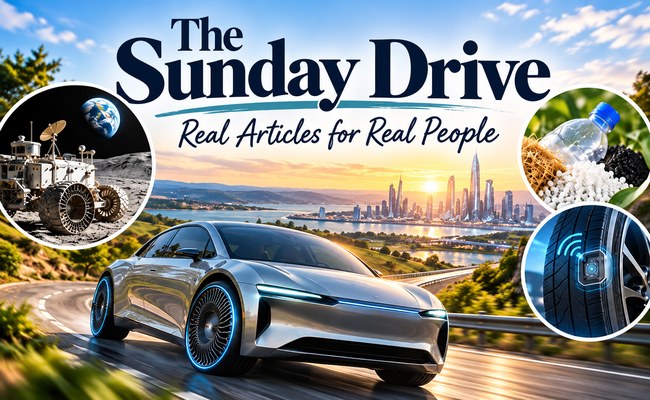
Airless tyres, talking tyres, recycled plastic bottles and wheels designed for the Moon. The future of the humble tyre might be stranger than we think.
THE SUNDAY DRIVE | ARTICLE 2
Real articles for real people.
By Debbie Mearns | Tyres 4 U Wirral
Put the kettle on. I’ve been looking into the future.
Not flying cars, unfortunately. Although I’m fairly certain somebody promised us those years ago.
Something a little closer to the ground.
Tyres.
We tend to imagine driverless cars, electric vehicles and dashboards with more screens than the average living room. But while we’ve been watching cars change, something rather interesting has been happening underneath them.
Tyres without air. Tyres that communicate with your car. Tyres made using rice husks and recycled plastic bottles.
Even wheels designed for the Moon.
Yes, the actual Moon.
I co-own a tyre business here on the Wirral, so tyres are something I hear about rather more often than most people. But I’m approaching this as a curious driver, not a scientist. I wanted to know what’s genuinely happening, what’s still experimental and what might actually make a difference to ordinary motorists.
Which got me wondering: what on Earth will we actually be driving on in 2040?
A tyre without air? Now you’ve got my attention.
Imagine driving over a nail and carrying on without a puncture.
No flat tyre. No roadside tyre change. No searching the boot for a repair kit you’ve never used.
Michelin has developed something called UPTIS, an airless tyre-and-wheel system. Instead of relying on compressed air, it uses a flexible internal structure to support the vehicle.
It looks rather like a normal tyre that’s had its middle replaced with something from a science-fiction film.
But it’s real.
Michelin has tested UPTIS on delivery vehicles and reports that its prototypes had travelled more than 4.5 million kilometres by the end of 2023.
That’s an awful lot of parcels.
And probably quite a few left behind bins.
However, UPTIS remains a technology being tested, not a standard replacement for the average family car.
Questions remain around cost, lifespan, regulation and suitability for different vehicles. Removing the air eliminates conventional pressure-loss punctures, but it doesn’t make a wheel indestructible.
I can see the attraction, particularly for delivery drivers and anyone who’s experienced a puncture at precisely the wrong moment.
Would I try one? Absolutely.
Would I want to know the price first?
Of course.
Some things never change.
Excuse me, your tyre is trying to tell you something.
Pirelli has developed something called Cyber Tyre.
Sensors inside the tyres communicate information to the vehicle’s electronic systems, helping them respond to tyre conditions.
This goes beyond the familiar low-pressure warning.
And it isn’t entirely theoretical. The technology has been integrated into the Pagani Utopia Roadster, an extraordinarily expensive Italian sports car.
So yes, talking tyres exist.
They’re just not something most of us will find on the family hatchback quite yet.
But more technology also raises questions.
What happens when a sensor fails? Will replacement tyres cost more? And if tyres collect information, who gets to see that data?
Modern cars already have an impressive collection of warning lights. Sometimes it feels as though the car knows exactly what’s wrong but prefers to communicate through a mysterious orange symbol.
Better information could improve safety. More complexity could also mean more expense.
I suspect most drivers will judge connected tyres by one question:
Does it genuinely make my life easier?
Formula E has just given us a glimpse of the future.
On 30 September 2026, Bridgestone unveiled its new POTENZA GEN4 tyres in Rome, ahead of supplying Formula E’s next generation of electric racing cars.
What caught my attention wasn’t just the racing.
It was what the tyres were made from.
Bridgestone reported a 65% allocation of recycled and renewable materials, including silica derived from rice husks and carbon black produced using oil recovered from old tyres.
That percentage follows a certified material-accounting method; it doesn’t necessarily mean each finished tyre physically contains exactly 65% recycled and renewable ingredients.
Still, it’s fascinating.
Motorsport allows manufacturers to test new ideas under demanding conditions. But racing tyres and ordinary road tyres have very different jobs.
Most of us would prefer our tyres to last rather longer than a Sunday afternoon.
And work in the rain.
And not cost a small fortune.
Not everything developed on a racing circuit reaches the road, but some of the research may eventually benefit everyday drivers.
Unfortunately, I don’t think we’ll be getting a pit crew with every set.
Shame, really.
Apparently, the future of tyres involves rice.
Did you know rice husks can play a part in making tyres?
Neither did I.
When rice is processed, its outer husks are removed. Their ash can produce silica, an ingredient used to help balance grip, wear and rolling resistance.
Continental already uses rice-husk silica and polyester made from recycled plastic bottles. Depending on tyre size, it says the equivalent of nine to fifteen bottles can be reused in one tyre.
According to its 2025 annual report, Continental says renewable and recycled materials accounted for 28.1% of the production materials it purchased for tyres.
Meanwhile, Goodyear has demonstrated a tyre containing 90% sustainable materials according to its own definition, including ingredients such as soybean oil and rice-husk silica.
At this point, I wondered whether somebody had mixed up the tyre factory with the kitchen cupboard.
But there’s an important distinction: Goodyear’s 90% tyre was a demonstration product, not an ordinary retail tyre. Its ambition to develop a fully sustainable-material tyre by 2030 is a goal, not an achievement.
And we should be careful with the word sustainable.
Recycled ingredients don’t automatically make a tyre environmentally harmless. Manufacturing uses energy, tyres wear down and eventually need replacing.
What happens to old tyres deserves an article of its own.
For now, the challenge is reducing environmental impact without compromising safety and performance.
Because even a tyre made using extraordinary ingredients still needs to stop your car safely on a wet British road.
Preferably without a recipe book.
Innovation isn’t just for expensive tyres.
Futuristic tyre headlines often feature premium manufacturers such as Michelin, Pirelli and Continental.
But engineering improvements aren’t exclusive to expensive products.
Technologies such as silica compounds and carefully developed tread patterns can be found across different price ranges, although performance still varies considerably between individual tyres.
That’s why independent tests and tyre-label information matter more than impressive marketing descriptions.
A budget tyre might be perfectly suitable for one driver, while another might reasonably choose to spend more for particular performance characteristics.
After all, most of us aren’t driving around in a Pagani.
We’re simply trying to get to work, collect the children and make it to the supermarket before it closes.
Electric cars are changing the rules.
Electric vehicles are already influencing tyre design.
Some are heavier because of their batteries. Many deliver power quickly. And because electric motors are quieter, tyre noise can become more noticeable.
Manufacturers are responding with designs that balance efficiency, durability, grip and comfort.
Hankook already sells its iON range developed with electric vehicles in mind.
But here’s something worth understanding.
Not every electric vehicle needs a tyre specifically labelled as an EV tyre.
The correct size, load index, speed rating and vehicle-specific requirements are what matter.
Some heavier electric vehicles need tyres capable of carrying greater loads, but that doesn’t automatically mean they require a special EV label.
Different drivers may reasonably choose different tyres.
Someone covering thousands of motorway miles may have different priorities from someone making short local journeys.
Neither is automatically wrong.
Longer life. Better efficiency. Less noise. Strong wet grip.
And we’d all quite like them to be affordable too.
No pressure, then.
And now, apparently, we’re going to the Moon.
Did you know the three Apollo lunar rovers are still sitting on the Moon?
Their wheels used metal-mesh technology rather than ordinary air-filled tyres, and Goodyear contributed to their development.
Decades later, engineers are still exploring wheels for lunar travel.
Michelin has developed MiLAW — Michelin Lunar Airless Wheel — which received a Concept of the Year award at the Tire Technology Expo in March 2026.
It’s designed for conditions that make even the worst British winter seem positively tropical.
Extreme temperatures. Harsh terrain. Radiation.
And absolutely no tyre centre around the corner.
Michelin hopes this research will also contribute to technology used here on Earth.
That’s a possibility, not a guarantee.
But I love the idea that something developed for exploring the Moon might eventually help improve everyday transport.
Although I don’t expect we’ll all be driving around Wirral on lunar wheels by 2040.
They might be handy for the occasional pothole, though.
But will any of this actually save us money?
Now we’re getting to the question many readers are probably thinking.
What will it cost?
Airless tyres could reduce puncture-related inconvenience and downtime, but a higher purchase price might change the calculation.
Connected tyres might improve safety, but what about replacement sensors and compatibility?
And environmentally improved materials don’t automatically mean cheaper tyres.
Consider a hypothetical example.
A £100 tyre lasting 20,000 miles costs 0.5p per mile.
A £150 tyre lasting 40,000 miles costs 0.375p per mile.
The more expensive tyre works out cheaper per mile.
But real life isn’t that simple.
Wet grip, suitability, ageing, annual mileage and how long you keep the vehicle all matter.
Someone driving only a few thousand miles each year might never use the additional potential mileage before the tyre ages or the car is sold.
And someone with a limited budget might reasonably prefer a suitable, more affordable tyre now.
That’s why I wouldn’t judge a tyre on brand or price alone.
A budget tyre might suit one driver’s needs, while another might choose to pay more for particular performance characteristics.
Independent tests where available, together with efficiency, wet-grip and noise ratings, can help us compare individual models.
The cheapest option isn’t automatically the best value.
Neither is the most expensive.
And I suspect that will still be true in 2040.
So, where are these inventions now?
| Technology | Where it stands in 2026 |
|---|---|
| Rice-husk silica and recycled-bottle polyester | Already used in tyre manufacturing |
| EV-focused tyres | Available to buy |
| Pirelli Cyber Tyre | Limited specialist vehicles |
| Michelin UPTIS airless tyres | Real-world testing |
| Goodyear’s 90% sustainable-material tyre | Demonstration technology |
| Michelin MiLAW lunar wheel | Research and development |
Being invented, being tested and being available to buy are three very different things.
One more thing. Our cars are getting older.
Here’s something that could shape what we’re driving on in 2040.
According to the Society of Motor Manufacturers and Traders, the average car on UK roads was 9.7 years old in 2025, and a record 45.7% were more than ten years old.
That’s interesting because new technology doesn’t reach every driver at the same speed.
Something built into a brand-new vehicle, such as sophisticated connected-tyre electronics, may take years to become commonplace as older cars remain on the road.
But improvements to ordinary replacement tyres are different.
You don’t necessarily need a new car to benefit from advances in tyre materials, tread design or manufacturing.
Some of those improvements could arrive the next time you need replacement tyres.
And that might be the most interesting prediction of all.
The future of tyres could reach our existing cars long before the cars themselves become futuristic.
My bet for 2040?
Here’s what I think.
Most of us will still be driving on recognisable, air-filled tyres in 2040 — but the materials and technology inside them will have changed considerably.
Conventional tyres already work across an enormous range of vehicles. Replacing such established technology isn’t simple.
Meanwhile, improvements in materials, manufacturing and construction are already happening.
I suspect those quieter changes will reach ordinary drivers sooner than completely airless wheels.
Connected tyres may become more common where they offer genuine safety benefits.
But not every invention will suit every driver.
What I’d really like to see is technology that delivers practical improvements.
Safer journeys. Quieter cars. Longer-lasting tyres. Fewer inconvenient breakdowns.
And perhaps manufacturing that uses fewer resources.
Those may not sound as exciting as wheels designed for the Moon.
But for ordinary drivers, they could matter far more.
One final question before you finish your tea.
We’ve spent more than a century getting used to tyres filled with air.
Now manufacturers are experimenting with ways to remove the air, add electronics and use ingredients that once seemed completely out of place in a tyre factory.
So here’s what I’d love to ask you.
Would you trust a tyre without air?
Would you welcome a tyre that communicates with your car?
Or would you prefer manufacturers to concentrate on making today’s tyres safer, longer-lasting and more affordable?
I can see good arguments for all three.
Perhaps the future won’t be about everybody wanting the newest invention.
It’ll be about having choices that genuinely work for different people.
Now, I’m off to finish my tea.
And possibly investigate whether somebody really is going to invent that flying car.
Until next Sunday,
Debbie Mearns
The Sunday Drive
Real articles for real people.
Cars • Costs • Safety • The Future
A note on the research
This article was researched in October 2026 using information from tyre manufacturers, their published research and industry statistics, including SMMT. Some figures are reported by the manufacturers themselves rather than independently verified. Experimental technologies, future availability, environmental benefits and eventual customer costs remain uncertain. Where I’ve made a prediction about 2040, it’s my opinion rather than an established fact.